
Batteries get most of the attention in energy storage, yet they are not good at everything. They struggle with sudden, large bursts of current, they wear out after roughly 1,000 to 10,000 cycles, and they do not like the cold. At Boise State University, researchers have just reported a printable material that could help close those gaps from the other side, by making better supercapacitors that can be printed onto flexible surfaces.
According to Boise State News, a team led by alum Fereshteh Rajabi Kouchi, who earned her PhD in materials science and engineering in 2025, invented a first-of-its-kind two-dimensional metal alloy ink. Her supervisor, Professor David Estrada, says the work shows how alloy engineering and additive manufacturing fit together.
Why supercapacitors, and why ink
Supercapacitors work differently from batteries. As Estrada explains in the university’s release, they store charge physically rather than through chemical reactions. That gives them a very long life, on the order of a million cycles, and makes them useful where power is needed fast: backup power that bridges short outages, wearable electronics and sensors, and pulsed-load or emergency systems in aerospace.
Printing is attractive because it can produce small, flexible devices in precise patterns. But the ink matters enormously. Estrada notes that materials are the heart of any electronic system, and without understanding how a fabrication process changes a material’s properties, it is nearly impossible to get repeatable results that move from the lab to a factory floor.
What the team made
Kouchi’s goal was to widen the range of inks available for printed supercapacitors by using alloys, which are mixtures of two or more metals. She blended niobium, tantalum and sulfur into a new 2D ink. The material belongs to the family of 2D transition metal dichalcogenides, or TMDs, which are only three atoms thick, with a metal layer sandwiched between two layers of chalcogen atoms such as sulfur.
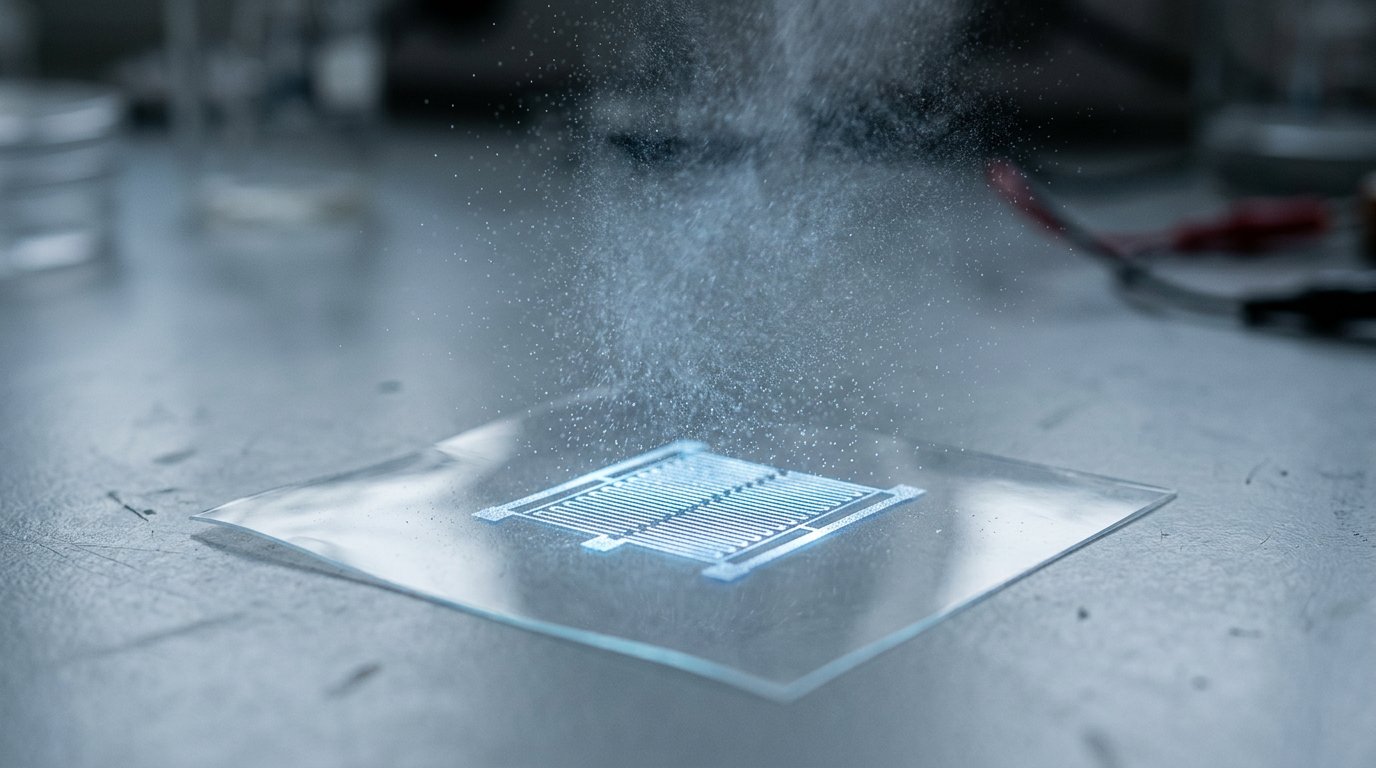
The team printed the ink with an aerosol jet printer, which turns the ink into a fine mist and deposits it on a surface in precise patterns. The alloy ink could be printed in features as small as 50 micrometers, roughly the diameter of a human hair.
The headline result is performance. Supercapacitors made from the alloy ink stored far more charge than devices made from either metal-based TMD on its own. Kouchi describes seeing the alloy outperform both of its parent materials as a sign that the composition of a 2D system can be used as a design tool for energy storage.
Solving the practical problems
Making a printable ink from a brand-new alloy meant solving several problems at once, Kouchi says: keeping the nanosheets stable, preventing oxidation, and controlling how the droplets dry. The ink dried uniformly and met the material requirements for printing on flexible substrates, such as those used in wearable skin-based electronics.
The work builds on Boise State’s decade-long history with stable, aerosol-jet-printable inks. Kouchi earlier reported a similar study on 2D transition metal carbides, known as MXenes, which showed excellent energy density but lower power density than the new alloy inks. The research was supported by NASA EPSCoR, the National Science Foundation’s Center for Atomically Thin Multifunctional Coatings, and the Penn State Two-Dimensional Crystal Consortium Materials Innovation Platform, with collaborators at Penn State, the University of Illinois Chicago, Tulane University and Southern Methodist University.
What it means
The practical promise is a general recipe rather than a single device. Estrada describes Kouchi’s work as a general approach for turning newly discovered layered materials into printable inks, which brings flexible, miniaturized power sources for the Internet of Things closer to reality. If that holds up, designers of wearables and distributed sensors could print small, fast-charging, long-lived power elements directly where they are needed, instead of squeezing in a separate coin cell.
It is worth keeping expectations measured. The university release describes laboratory results and does not give capacitance figures, device lifetimes or cost, and nothing in it suggests a product is imminent. The sensible reading is that the alloy-ink strategy works at small scale and deserves follow-up on durability, scale-up and cost.
For readers following energy storage, the story is also a reminder that progress is not only about bigger batteries. Pairing batteries, which hold lots of energy, with supercapacitors, which deliver and absorb power quickly, is a long-standing design idea. Better printable materials make that pairing more practical for tiny devices as well as large ones.
The bottom line
Boise State’s niobium-tantalum-sulfur ink is an early but concrete step toward printed supercapacitors that are small, flexible and strong. The key finding, that the alloy beats both of its parent materials, suggests that mixing metals at the atomic level is a useful lever for the next generation of printed power.