
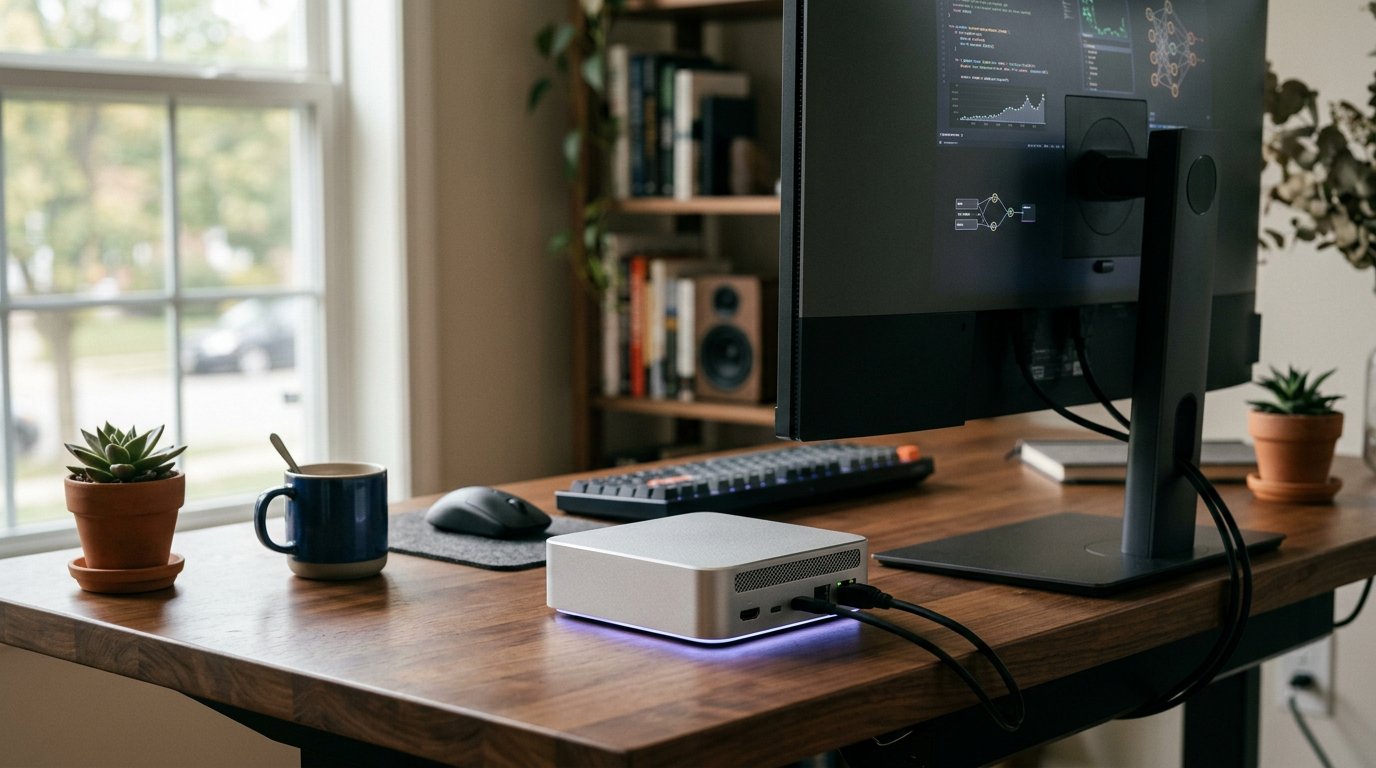
The always-on AI agent has a new home, and it is small enough to sit beside a monitor. On November 18, 2026, ASUS announced the availability of the ProArt GR1X, a mini PC built around the NVIDIA RTX Spark superchip and designed to keep local AI agents running around the clock, according to the ASUS Pressroom announcement.
The pitch is simple: agents that read your files, drive your apps and call large models work best when they never go to sleep, and when every task does not trigger a per-token bill. ASUS says the GR1X is built for exactly that job.
What is inside the ProArt GR1X
ASUS describes the machine as a Windows 11 PC powered by NVIDIA RTX Spark, a platform that pairs a 6,144-core Blackwell RTX GPU with a 20-core Grace CPU over NVLink-C2C. Both processors share one pool of unified memory, which can be specified at 128GB or 64GB. ASUS lists up to 1 petaflop of FP4 AI performance for the top configuration.
Connectivity is generous for such a small box. The company cites 10GbE LAN, WiFi 7, Bluetooth 5.4, four USB 3.2 Gen 2×2 Type-C ports and HDMI 2.1, with support for up to four 4K displays and HDMI output up to 8K. Storage comes through dual M.2 NVMe slots supporting PCIe 5.0 and 4.0 drives.
The chassis measures 150 x 150 x 51mm and weighs 1.48kg, and comes in anodized black or sandblasted silver. Inside, ASUS describes a dual-fan system with 218 fan blades, 57 ultra-wide fins and four heat pipes handling a 140-watt TDP, with seven-level fan control. That cooling design is what the company credits for 24/7 operation as an agent host.
Local models, private by default
The central claim is about where the work happens. ASUS says the GR1X supports 120B-parameter large language models with up to 1 million tokens of context, enough for an agent to work through an expansive codebase or a long-running project. Because inference happens on the desk, personal data stays on the machine rather than being uploaded, and users avoid per-token or per-generation fees.
It is not an all-or-nothing design. ASUS says users choose where each task runs: fully local, in the cloud, or a hybrid based on performance, cost and privacy. The PC runs NVIDIA CUDA natively on Windows 11, with RTX acceleration for 3D, video and AI applications, so agent and creative workflows need no dual-boot or separate Linux environment.
The software ecosystem around it
Hardware alone does not make an agent host, so ASUS lists a set of software partners. The company has a strategic partnership with Nous Research to bring Hermes Agent, an open-source autonomous agent that operates across desktop apps, the terminal and local files, to ProArt RTX Spark PCs. Hermes connects to ASUS MuseTree through an official skill, and it can drive ComfyUI, the open-source visual workflow platform, for which ASUS provides validated workflows and resource packs for AI image and video generation.
ASUS also bundles its own tools. Zenni Claw is a local AI agent for daily tasks and ASUS device control. MuseTree handles local image and video generation with FLUX and Wan models. StoryCube uses AI scene recognition to organize media and manage assets. Creators also get a complimentary three-month Adobe Creative Cloud subscription, including Premiere.
The GR1X joins the ProArt P16 and P14 laptops in what ASUS calls the ProArt RTX Spark family, bringing the same local agentic platform to a desktop form factor. ASUS positions the wider portfolio as a ladder from personal AI PCs up to the Ascent GX10 (NVIDIA DGX Spark) and the ExpertCenter Pro ET900 (NVIDIA DGX Station) for heavier development work.
What it means
For individual creators and small teams, the GR1X is a bet that the economics of agents favor owning the compute. A task that runs all night against a hosted model can add up quickly; a one-time hardware purchase shifts that cost to a fixed number. Privacy is the other draw, since prompts and project files never leave the device unless the user chooses a cloud route.
There are caveats. The performance figures, including the 1 petaflop FP4 number and the 120B-parameter model support, come from ASUS rather than independent testing. FP4 throughput is a specific measure and will not translate directly to every workload. ASUS also says pricing and availability vary by region and does not give a price in its announcement, so buyers should check local listings. The press release is also inconsistent on thickness, listing 15mm in the headline specs and 51mm in the body text, so confirm dimensions with a retailer before planning a desk setup.
Bottom line
The ProArt GR1X is a clear example of the AI PC moving from a laptop feature to a dedicated, always-on appliance. Whether local agents become a mainstream habit will depend on pricing, real-world speed and how polished tools like Hermes Agent feel in daily use. For now, ASUS has put a credible, compact option on the market in 128GB and 64GB configurations.