
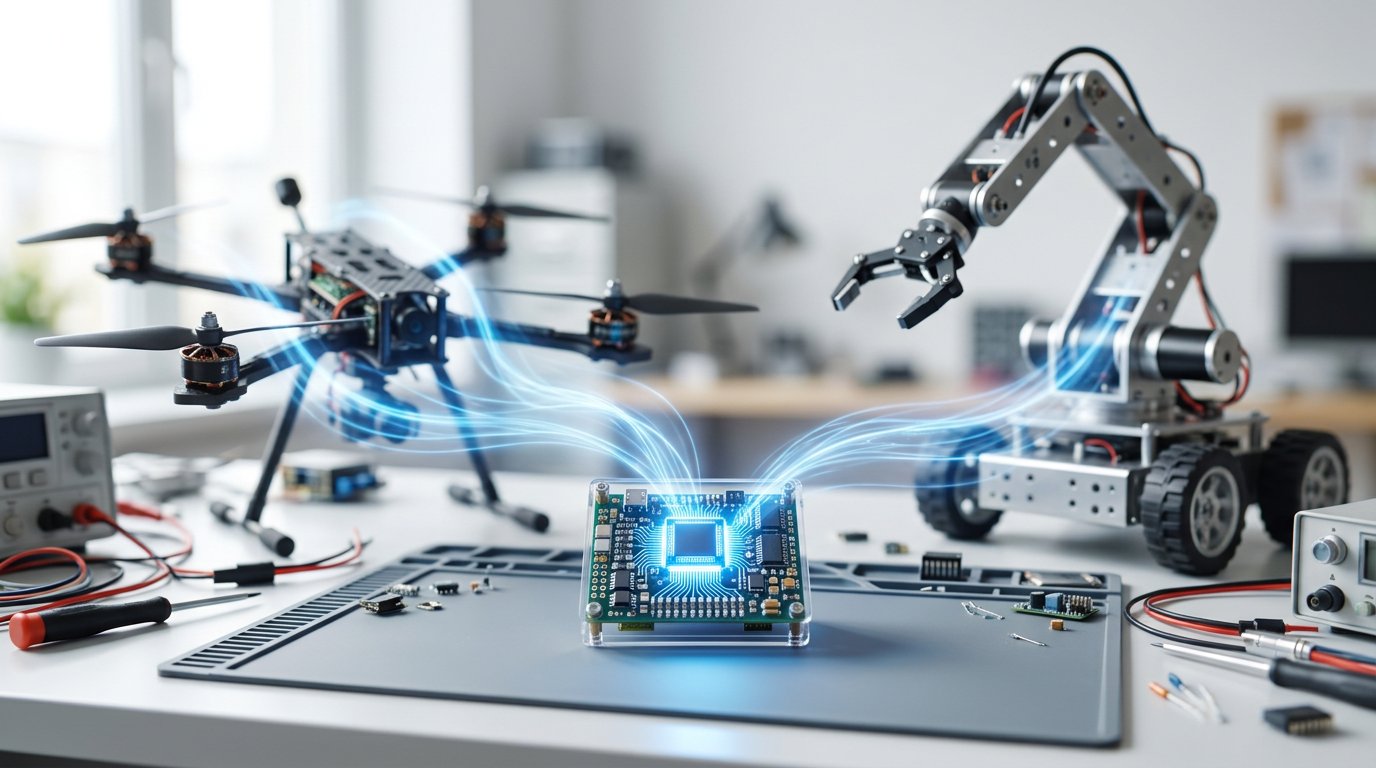
Robots and drones increasingly want to run language and vision models on board, but the chips inside them have strict limits on power and memory. On November 17, 2026, edge AI company SiMa.ai announced Palette 3.0, a software release it says squeezes more out of a single low-power chip, with speculative decoding that lifts generation speed by up to 3.5x.
Everything below is drawn from SiMa.ai’s own press release, so the performance claims are the company’s and have not been independently verified here.
What Palette 3.0 is
SiMa.ai describes itself as a Physical AI company, building software and silicon for machines that sense and act in the real world. Palette 3.0 builds on the company’s June announcement of Agentic Palette. The new release focuses on running several AI models at once on a single chip while staying inside a tight power budget.
CEO Krishna Rangasayee framed the problem as a mismatch: software that evolves monthly against silicon that takes years to adapt. Palette 3.0, he said, is meant to deliver hardware at the speed of software, so customers can deploy new model capabilities on hardware they already own.
Running many models on one chip
According to the release, Palette 3.0 allows complex reasoning and multi-model workloads to run concurrently on a single Modalix MLSoC while keeping a low-power profile. That includes running separate Docker containers on the chip itself. The company says this supports large language models and vision-language models alongside the perception models robots need, all within tight power and memory constraints.
The release also says Palette 3.0 speeds up the perception, depth and reasoning models that drones and robots rely on. With ecosystem partners, the platform adds unified sensor fusion, dense neural depth fields and closed-loop digital twin simulation, aimed at removing integration and validation bottlenecks in autonomous development.
Faster text generation with speculative decoding
The headline number is speed. SiMa.ai says it added open-source support for the EAGLE3, DFlash and Gemma 4 MTP speculative decoding algorithms. Speculative decoding lets a model draft several tokens ahead and verify them, which can raise throughput without changing the final output. The company claims up to 3.5x more tokens per second within a low power budget.
It also reports support for Mixture-of-Experts models with many parameters, citing OpenAI’s GPT-OSS-20B running on the Modalix MLSoC 16GB SoM. The code is available on GitHub, and a new Model Browser shows how models perform under real-world power constraints.
What it means
If the claims hold up, the practical benefit is flexibility. A robot maker could add a reasoning model or a better depth model through a software update rather than a hardware redesign, and still fit the power envelope of a battery-powered machine. Open-source tooling and published model benchmarks also make it easier for developers to test those claims themselves.
Caveats apply. The 3.5x figure is a best case, the release points readers to the company for competitive benchmark details, and real products will depend on partners and developers adopting the toolchain. SiMa.ai is hosting webinars on December 2 and December 8, 2026 for those who want a deeper look.
Bottom line
Palette 3.0 is a bet that the future of robotics is decided as much by software efficiency on small chips as by raw compute. It is worth watching as more physical AI moves from the cloud to the machine itself.