
Building a robot application has long meant stitching together drivers, calibration scripts, simulators and perception code before a single useful task runs. On November 17, 2026, Google’s Gemini Robotics team described a way to compress that work: a fast general model, Gemini 4 Hydrogen, paired with a new Robotics plugin for Google Antigravity. The company says a developer can go from a robot in a box to a working application in an afternoon.
A faster model built for embodied reasoning
According to the Google Developers Blog post, Hydrogen was introduced the week before as a model “built for speed and efficiency” that still carries strong spatial and embodied reasoning. It follows Gemini 4 Argon and Gemini 4 Carbon, which Google says brought frontier physical reasoning to robotics, including understanding 3D scenes and controlling robot arms directly from camera images.
Hydrogen keeps that control ability. You give it a goal in plain language and a camera view, and it plans the task, writes and runs the control code, and keeps adjusting until the job is done. Google reports that on the Artificial Analysis Robotics 0.1 benchmark, which has a real six-axis arm attempt eight everyday tabletop tasks such as pouring a drink or packing blocks into a box, Hydrogen scores 58. That is similar to Argon, but at a lower cost per token.
The model also absorbs skills that used to live in a separate product. Google says Hydrogen brings the capabilities of its Gemini Robotics ER 2 embodied reasoning models into the core Gemini 4 series and beats them on nearly every axis. On the public ERQA benchmark it outperforms ER 2 on spatial tasks such as multi-view correspondence and 3D trajectory reasoning, and Google recommends that current ER 2 users try Hydrogen for those workloads.
Antigravity as a robotics workbench
A capable model is only half of the story, and the post is candid about that. The new Robotics plugin for Antigravity packages the surrounding chores into skills the model can use on a developer’s behalf:
- Robot bring-up: installs drivers, discovers cameras, calibrates the arm and verifies safe motion, starting from a USB cable.
- MuJoCo in Antigravity: builds and previews simulated scenes and assets so ideas can be tried before touching hardware.
- Perception and control: uses Gemini’s spatial understanding to find objects, plan grasps and control the robot in a closed loop.
- Application building: uses Gemini’s coding skills to generate the controller and simulation for a full real-to-sim-to-real workflow.
In Google’s first demonstration, a developer plugs an I2RT YAM arm and a depth camera into a laptop and asks Hydrogen to bring it up. The plugin installs software, finds the camera, calibrates the arm and runs test motions, leaving the arm ready for tasks in about 10 minutes. Google says similar flows brought up a low-cost SO-ARM101 arm and an industrial-grade Franka Research 3 Duo from scratch.
From whiteboard sketch to working cell
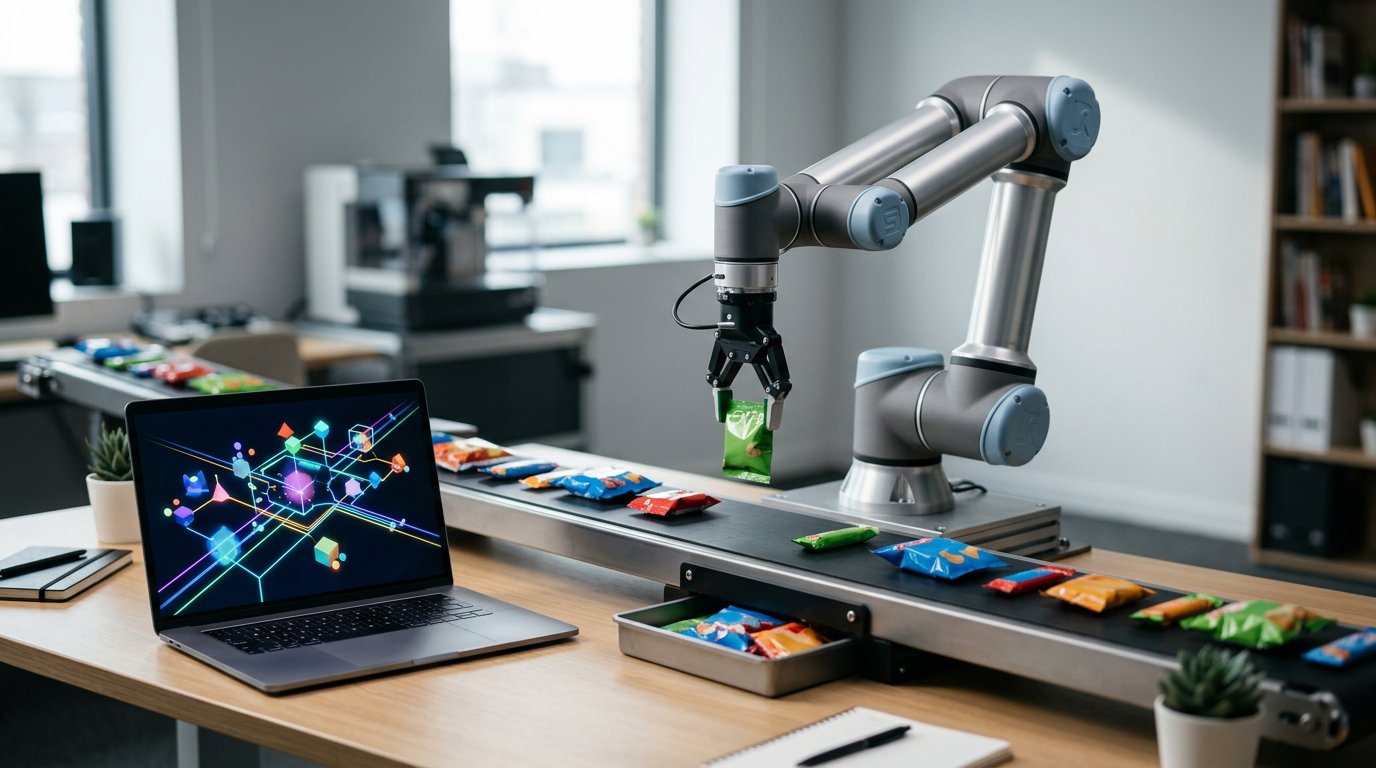
The more telling examples are applications. In a snack-sorting conveyor demo, a developer starts with a whiteboard sketch of a belt, mixed snacks and bins. From one prompt and images of a real scene, Hydrogen builds an interactive MuJoCo simulation, tests the grasping policy across several runs, then deploys the verified policy to the physical arm. When details need tuning, such as gripper closure force or sorting rules, the developer asks in natural language. Google says the arm reliably sorted snacks off the moving belt in about an hour end to end.
A second demo has Hydrogen build a small web storefront for a soap shop and connect it to two YAM Pro arms. When an order arrives, the arms set out a packing bin, pick the ordered bars and pull a printed thank-you note from a printer. Google argues Hydrogen’s efficiency is what makes it practical to run a multi-step application like this all day. A third demo has a dual-arm setup simulate a chess board and then play against itself or human opponents.
What it means
For teams exploring automation, the notable shift is where the effort goes. If setup, simulation and first-draft control code can be handled by an agent, small groups can test whether a task is worth automating without a dedicated robotics specialist. The simulation-first loop also lets a policy be validated repeatedly before it touches hardware, which matters for cost and for equipment wear.
It is worth keeping the claims in perspective. The figures above come from Google’s own post and a benchmark it cites, the demos use tabletop-scale arms, and Antigravity is limited to paid Google AI Pro or Ultra subscribers. Factory-floor reliability, safety certification and long-run maintenance are not covered by the announcement.
Developers can select the gemini-4-hydrogen model in Antigravity, call it through the Gemini API’s Interactions API with day-one support in the google-genai SDKs, or try spatial prompts and live camera streams in Google AI Studio. Google suggests starting with a prompt such as “Bring up my SO-101 arm and make it wave.”
Conclusion
Gemini 4 Hydrogen is less a new robot than a lower barrier to building one. By pairing a fast, cheaper model with a workbench that handles setup, simulation and code, Google is betting that the next wave of robot applications will be written by prompting. The real test will be how well those afternoon prototypes hold up in the messier conditions outside a demo.