
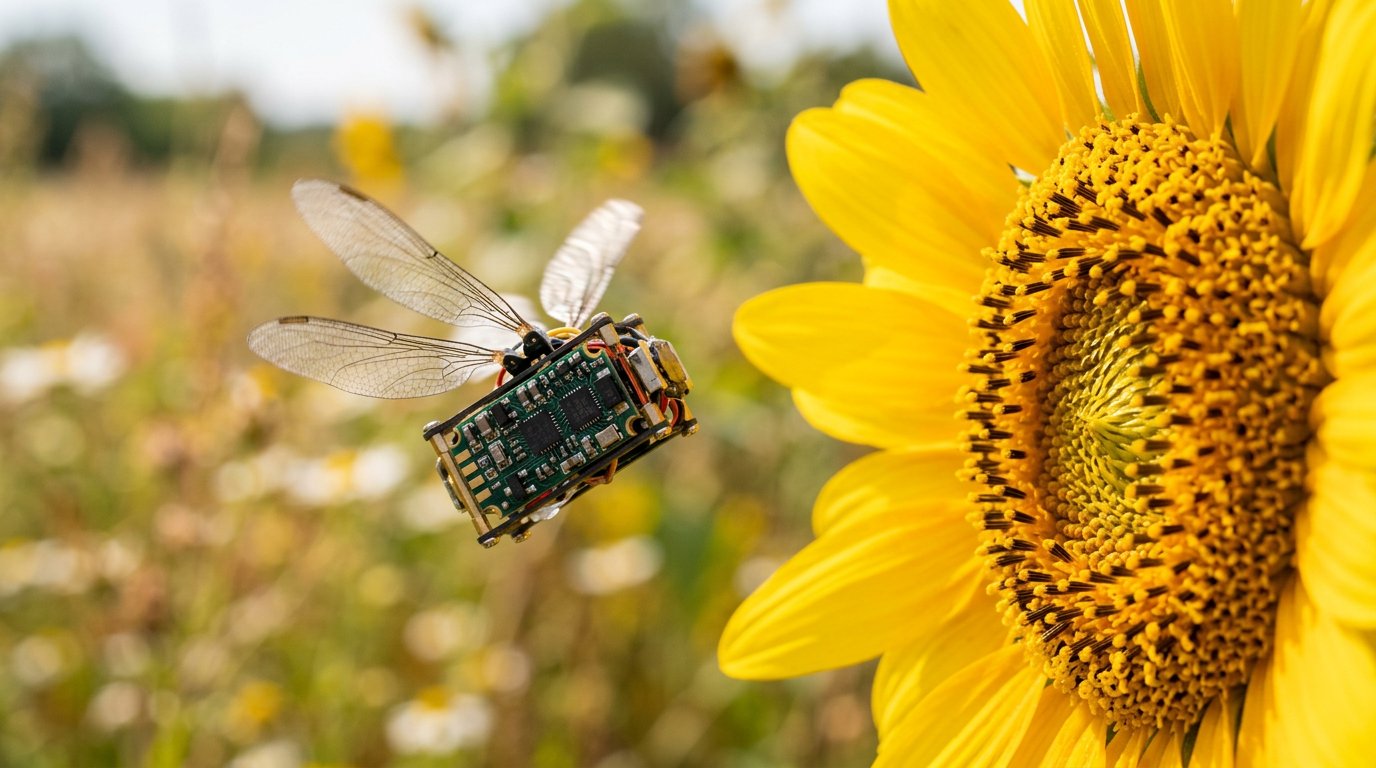
For a decade, MIT’s tiny flying robots have been remarkably athletic, with bumblebee-like speed, agility and durability. They had one big limitation: they were tethered to a laboratory motion-capture system because they could not carry the electronics needed to know where they were. According to MIT News, that has changed. A new version carries its own sensors and computer and still flies precisely.
Why weight was the obstacle
The robot is roughly the size and shape of a microcassette and weighs less than a paperclip. It has four wings, each driven by soft actuators, or artificial muscles, that flap rapidly. Adding navigation electronics to something this light is hard, because every extra milligram eats into lift, and without a motion-capture system the robot has no absolute sense of position and drifts off course.
The team’s first move was to scale up the artificial muscles without hurting performance. By carefully tuning the radius and length of the actuators, they increased their size by 50 percent while raising net lift force by 46 percent. The result is a lift-to-weight ratio of 1.9, enough to carry an electronics package that weighs only 244 milligrams.
Sensing fast, not perfectly
That package holds an inertial measurement unit to estimate attitude, an optical flow sensor to estimate lateral speed and position, and a time-of-flight sensor to measure height. A sensing algorithm computes orientation, angular velocity and position very quickly, with calculations simplified to keep the computing load small. The researchers found that estimating position continuously at a faster rate gave better results than a slower, more accurate estimate.
Lead author Yi-Hsuan (Nemo) Hsiao said the team spent a lot of time choosing sensors and position estimators so drift stayed very low, and that the robot now flies with accuracy comparable to flying with offboard cameras. The components are mounted on a fiberglass substrate so vibration from the wings does not disturb them.
What the flights showed
In tests, the robot hovered at different heights and followed point-to-point trajectories with positional errors of only a few centimeters. To show agricultural potential, the researchers used a joystick to send high-level position setpoints, guiding the robot around several plants and landing it carefully on a sunflower. Hsiao noted this is difficult even with a motion-capture system. Electronics use only about 6 percent of total power, with the rest feeding the muscles and wings.
What it means
Professor Kevin Chen called it the first demonstration of an aerial microrobot that is sensory and compute autonomous. MIT points to uses such as pollinating delicate blossoms in almond or blueberry orchards where natural pollinators have declined, and hovering near plants to monitor crop health and spot pests early without causing damage.
Important limits remain. The robot is still connected to an offboard power source, so it cannot yet fly untethered outdoors. The next goals are an onboard camera for object recognition and obstacle avoidance, and integrated power electronics and batteries. Because electronics draw so little power, the team sees room to add more components.
Conclusion
This is a research milestone, not a product, but it removes one of the biggest barriers between a lab curiosity and a field tool. If batteries and cameras can be added without losing agility, insect-scale robots could become a gentle new instrument for farms. The work is published in Science Robotics.