
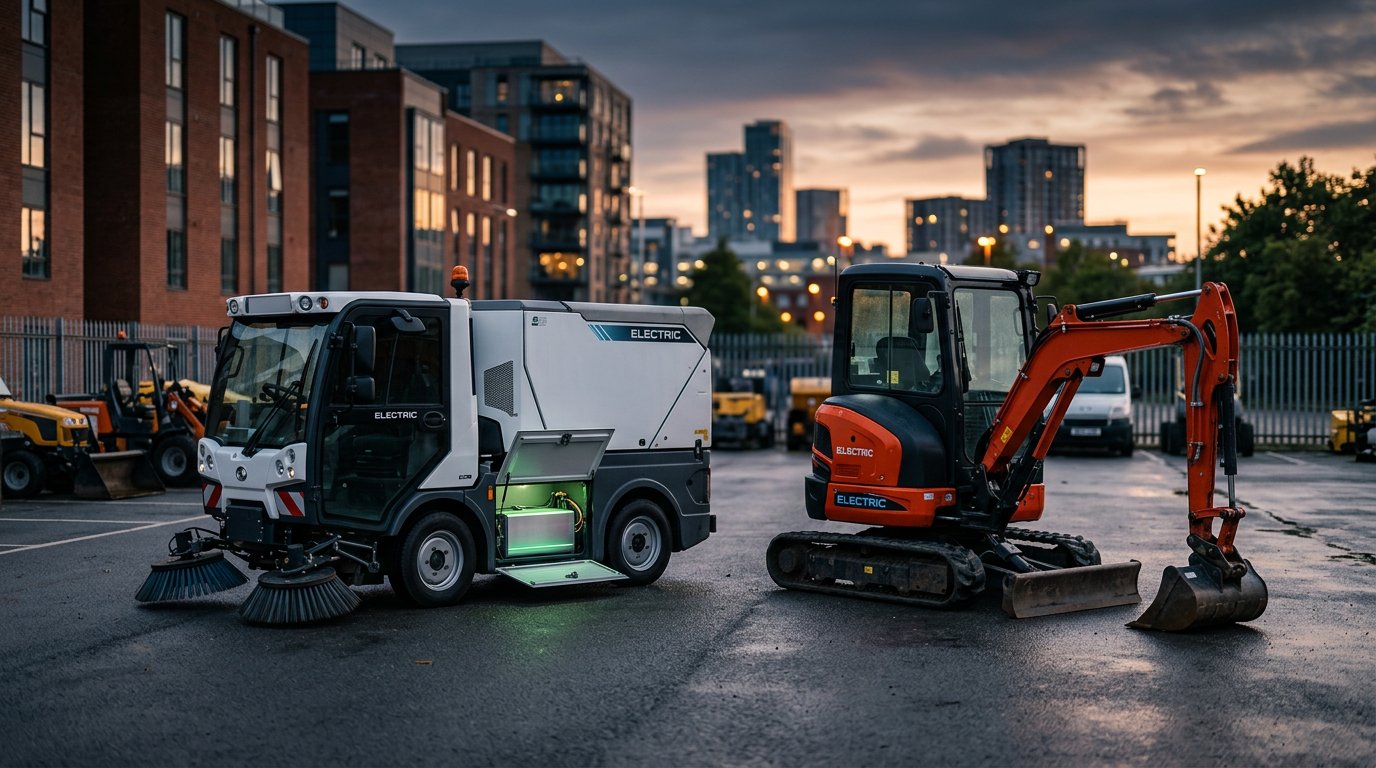
Compact street sweepers and mini excavators do their work in the places where noise and exhaust bother people most: city streets, building sites, farm yards. Yet their batteries have been a tight squeeze to design. On November 18, 2026, Forsee Power announced ZEN 8 LFP, a lithium iron phosphate battery aimed squarely at that niche, and built so that existing customers can swap it in without redesigning their machines.
The details below come from Forsee Power’s own press release, so the performance figures are the company’s claims rather than independent test results.
What Forsee Power announced
According to the company, ZEN 8 is a next-generation, compact LFP battery for urban cleaning equipment, commercial utility vehicles, construction machinery and agricultural vehicles. Forsee Power says it offers an energy density of more than 245 Wh/L, built around 173 Ah LFP cells and a 45V nominal module voltage.
The company says the new battery matches the energy capacity and voltage range of its earlier NMC-based ZEN 8, while improving performance and cycle-life targets. It also lists a targeted 0.7C fast-charging rate for demanding daily use.
Why LFP, and why no liquid cooling
Lithium iron phosphate is generally valued for robustness and cost compared with nickel-based chemistries, and Forsee Power leans on both points, citing LFP robustness advantages and competitive pricing. The company also says an optimized thermal architecture removes the need for liquid cooling. That matters for small machines: fewer pumps, hoses and coolant circuits mean less system complexity and an easier installation.
For compact electric street sweepers, Forsee Power cites configurations from 50 kWh to 130 kWh, targeting 8 hours of operation. For non-road machinery it names low-tonnage excavators, loaders, telehandlers and tractors.
A drop-in swap for existing customers
One of the most practical claims is mechanical. The new ZEN 8 is designed as a drop-in replacement for the existing ZEN 8 NMC battery, with the same external dimensions and mounting points. Forsee Power says that lets current customers move to LFP without vehicle redesign, cutting engineering effort, development cost and time to market.
For a machine builder, that is the difference between a quick component change and a new platform program. It is also a sensible way to let customers compare chemistries on the same chassis.
Made in Europe and ready for battery rules
The battery is manufactured in France. Forsee Power says that supports its goal of strengthening the European battery value chain and positions it for OEMs preparing for evolving European industrial and local-content requirements, including those under discussion in the Industrial Accelerator Act. The company also says the product is designed to comply with the applicable requirements of the EU Battery Regulation (EU) 2023/1542, including CE marking and Battery Passport obligations.
Chairman and CEO Christophe Gurtner said in the release that the company is combining exceptional LFP energy density, competitive pricing and European manufacturing in a solution designed for rapid industrial deployment.
What it means
Electrification of heavy equipment often stalls on small details: space, cooling, certification and cost. ZEN 8 LFP targets all four at once for a narrow but growing group of machines. If the drop-in claim holds up in practice, manufacturers of compact equipment get a lower-friction path to zero-emission models that run quietly in cities and on farms.
Several points remain to be confirmed: real-world cycle life, delivered pricing, and which customers adopt it first. The release does not say when volume shipments begin. Treat the numbers as targets until customers publish field results.
Bottom line
Forsee Power’s ZEN 8 LFP is an incremental but useful product: a denser, simpler, European-made battery that fits where the old one did. For anyone following clean energy storage in off-highway machines, it is a good example of chemistry changing without forcing a redesign.