
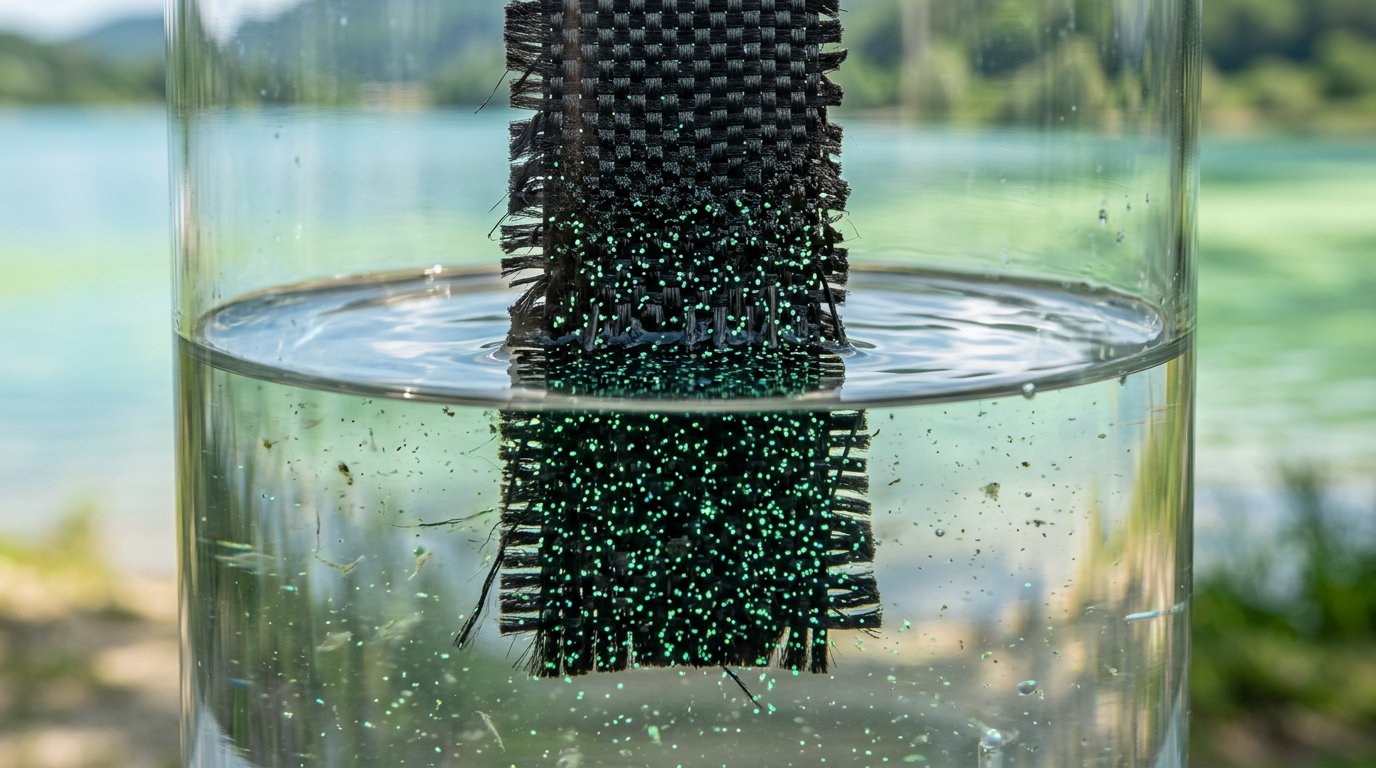
Phosphate is a double-edged molecule. Farmers need it to grow crops, yet when rain washes fertilizer into lakes and rivers, the same nutrient can feed harmful algal blooms that starve water of oxygen. On November 18, 2026, Northwestern University announced that its researchers, working with Argonne National Laboratory, had built a reusable fabric electrode that pulls phosphate out of water and can hand it back on demand. The details below come from the university’s news release.
A cloth with a voltage switch
The electrode starts as ordinary carbon cloth, chosen because it conducts electricity and has a large surface area. The team cleaned it and then dipped it three times into a solution of magnetite nanoparticles, coating it much like paint. Magnetite is a common iron oxide, and its surface binds phosphate. The nanoparticles do part of the job on their own, but the real trick is the electricity.
When the researchers applied 1.2 volts across the electrochemical cell, the cloth captured about 2.6 times more phosphate than the same cloth with no voltage. Reversing the voltage made it let go. As senior author Vinayak Dravid put it, the approach uses electrons as a controllable switch to capture and release phosphate without adding chemical regenerants.
Why current methods fall short
According to the release, today’s phosphate removal often relies on adding chemicals such as metal salts that attract the nutrient. Those steps can raise costs, shift the water’s pH and create secondary waste that needs its own disposal. A material that releases what it captured with a simple change in polarity avoids that chemical loop. The phosphate comes off in a surrounding solution, which is where recovery could begin.
The motivation is twofold. First-author Kelly Matuszewski noted that even small, dilute amounts of phosphate in wastewater and stormwater cause trouble, from the Great Lakes region to the Gulf of Mexico. At the same time, phosphate is a finite, critical mineral used in fertilizer, so recovering it makes more sense than discarding it.
What the study actually shows
The work, titled “Voltage-switchable phosphate recovery using magnetite-coated electrodes in hybrid capacitive deionization,” appeared in ACS ES&T Engineering. The electrochemical experiments took place at Argonne, where Matuszewski worked as a visiting graduate student with scientist Lauren Valentino, a co-corresponding author. Funding came from the National Science Foundation, including the Great Lakes ReNEW Engine and a Small Business Innovation Research Phase II award.
It is important to read the claims narrowly. These are laboratory tests, not field results. The release does not report how many cycles the cloth survives, how much phosphate a square meter can hold, or how it behaves with the mix of salts and organic matter in real wastewater.
What it means
If the approach scales, utilities and agricultural regions could treat nutrient pollution and recover a fertilizer ingredient in one reusable step, with electricity replacing a chemical supply chain. That would fit a wider push toward circular handling of nutrients, where wastewater is treated as a source of material instead of just a problem.
The team’s next steps are testing in a real wastewater matrix at the same lab scale, then scaling up. It may also extend the strategy to other metal-oxide nanoparticles. The release also notes that two authors are inventors on a provisional patent application, and that Dravid is a founder, equity holder and board director of Coral Innovations, a water-treatment technology company.
Conclusion
A piece of black cloth that grabs phosphate when charged and drops it when the voltage flips is a neat idea, and it targets a problem that costs waterways dearly. The next test, real wastewater at larger scale, will show whether the switch works outside the lab.