
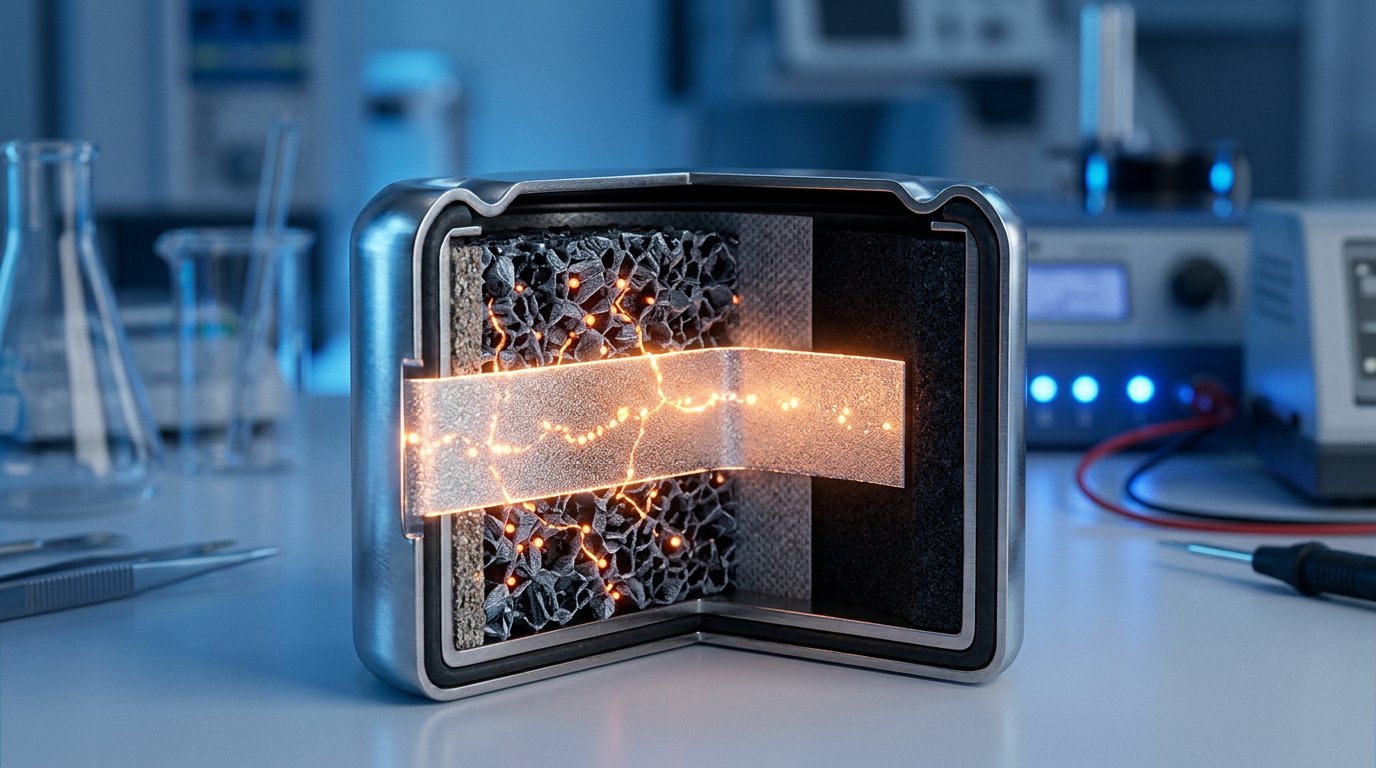
Open a lithium-ion battery and the negative electrode is usually a thin copper foil coated with graphite, mixed with binders and baked in energy-hungry steps. Researchers have long wondered whether one plain sheet of aluminum could do all of that work alone. A team at Tohoku University in Japan, working with UACJ Corporation, says a small pinch of manganese gets that idea noticeably closer to practical.
The result was announced by Tohoku University on November 19, 2026, and the underlying study appeared in Communications Materials on October 23, 2026.
Why aluminum foil is so tempting
According to the university, aluminum can store large amounts of lithium, and a single foil can act both as the active material and as the component that carries electricity. That “foil-only” design could remove the need for copper current collectors, binding materials and the energy-intensive coating processes used to make conventional anodes. In principle, that means batteries that are lighter, cheaper and more environmentally friendly to produce.
The catch is durability. The release explains that pure aluminum changes a great deal as lithium moves in and out during charging and discharging. When lithium is removed, the metal develops tiny gaps and turns porous, which weakens its structure. Repeated reactions with the battery’s electrolyte also build up surface layers that interfere with performance.
The silicon dilemma
One known fix is to add silicon to the aluminum, but the team notes that this creates a different problem: lithium becomes trapped deep inside the material and cannot be fully used. In other words, researchers could extend the electrode’s life or keep its usable capacity, but struggled to do both at once. That trade-off is the “delithiation bottleneck” named in the paper’s title.
What manganese changes
Instead of silicon, the team uniformly dissolved a small amount of manganese into the aluminum. Manganese is an element that does not readily interact with lithium. According to Tohoku, its atoms slow the movement of lithium through the aluminum, which encourages the foil to develop a fine network of internal boundaries as the battery operates. Those boundaries act as pathways that help lithium travel through the electrode more easily.
The payoff, as described in the release, is that lithium can be removed more thoroughly while the aluminum stays dense and stable. That helps prevent the damage that would otherwise shorten the electrode’s life. The researchers evaluated the alloy foil in a coin-cell battery, and the university’s photo shows the simple foil anode next to that test cell.
Assistant Professor Yuki Nakata of the Institute for Materials Research, a co-author, said the study shows that an electrode’s internal microstructure can organize itself during operation just by adding a trace of an element with low lithium affinity. He added that this approach relies on the material’s intrinsic properties rather than complex, pre-engineered nanostructures, which makes it a practical, low-cost strategy.
What it means
For battery makers, the appeal is manufacturing simplicity. Fewer materials and fewer coating steps could reduce cost and the footprint of production, and a lighter anode could help vehicles and devices. For researchers, the finding is a reminder that a tiny compositional tweak can steer how a material rearranges itself under stress, an approach that may carry over to other alloy electrodes.
It is important to read the claim narrowly. The release says the method improves durability and “mitigates” degradation; it does not state how many cycles the foil lasts, what capacity it holds, or how it performs in a full-size cell. The team itself says it must extend the electrode’s lifespan further to meet the demands of commercial batteries.
What comes next
Tohoku says the group will investigate improved alloy designs and protective surface coatings to push lifespan higher. If those steps succeed, aluminum-foil anodes could move from a laboratory curiosity toward simpler and more affordable rechargeable batteries. Until then, this is a clear, well-targeted step on a long road rather than a product announcement.
Conclusion
Adding a trace of manganese lets aluminum foil shed lithium more completely while staying intact, easing a stubborn trade-off that has held back foil-only anodes. The next proof point will be longer cycling in larger cells, which will show whether the shortcut to simpler batteries can scale.