
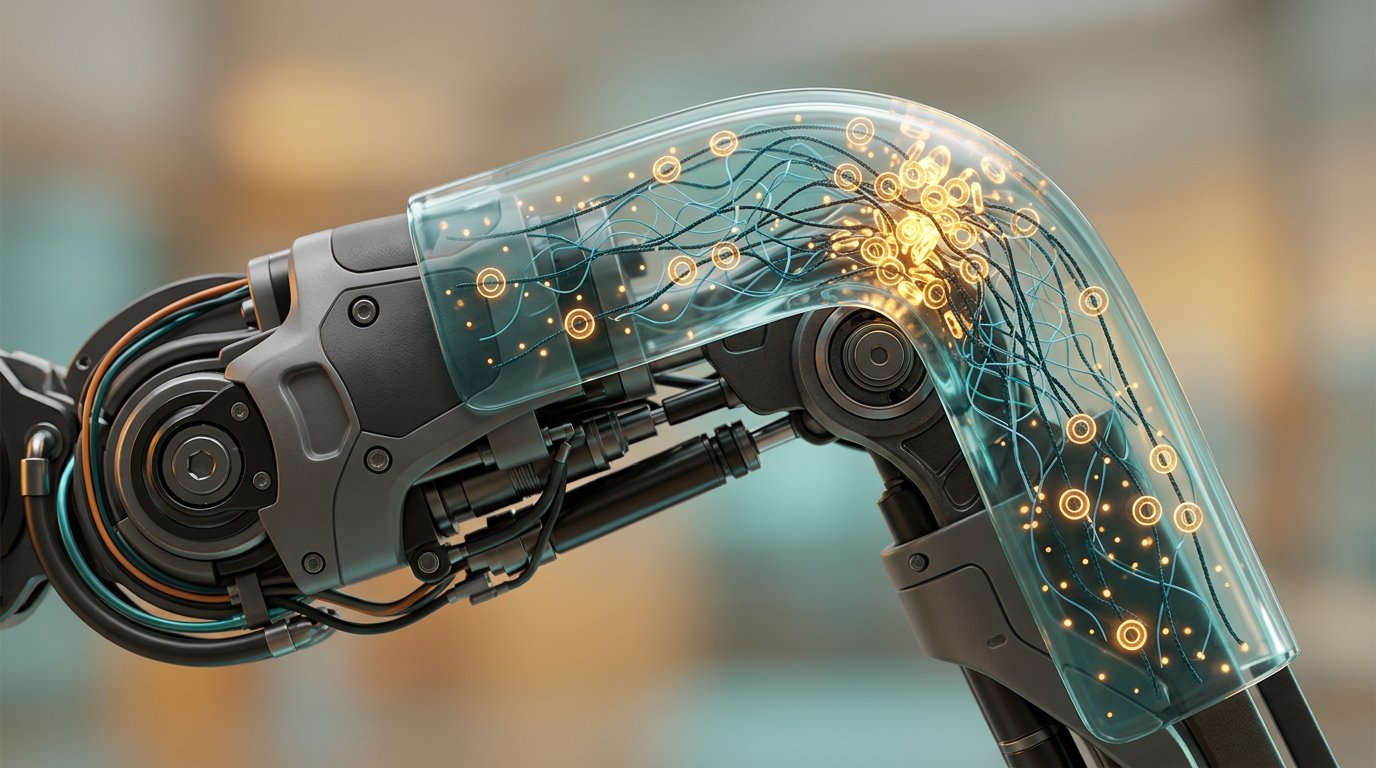
Most materials tire. Bend a paper clip enough times and it snaps, and plastics crack with age. A team at Washington University in St. Louis says it has made a polymer that does the opposite: the more it is bent and strained, the stronger it becomes. The result, led by chemistry professor Chenfeng Ke, was described in Nature Materials and in a November 20, 2026 story on the university’s newsroom.
How the material works
The polymer is a hydrogel, a flexible network that absorbs and holds large amounts of water. It is made from a biodegradable blend of sugar-based crystals and polyethylene glycol, a compound common in health products. The key ingredient is cyclodextrin, a sugar-derived molecule that forms ring shapes.
In the material, these rings sit along the polymer chains. When the hydrogel is stretched or bent, large clusters of rings break apart. The rings then slide along the chains and reorganize into smaller crystalline structures when the material relaxes. The university’s illustration compares it to beads on a necklace. The effect is that the polymer chains become more uniform and organized in exactly the places where strain is concentrated. The technical paper calls this mechanical adaptation driving self-strengthening in “adapt-ring” networks.
The 10,000-bend test
To check the idea, Ke’s lab applied the hydrogel to a flexible, knee-like joint and bent it 10,000 times. “The material performed just as we predicted,” Ke said. Areas that were not under strain stayed soft and pliable, a property that could matter wherever a rigid part would be a drawback. The patented polymer is also compatible with 3D printing, which the team sees as a route to custom shapes.
Ke describes the material as one that can remember, adapt, learn and grow. That is a bold way to put it, and the release is a university account of a peer-reviewed study, so those descriptions reflect the researchers’ framing rather than an independent review.
Borrowing from biology
The design takes cues from tissues like skin, where collagen gives strength and elasticity. Ke says some of the most impressive smart materials are found in biology, and the team used nature for inspiration. This work builds on his wider research into materials that mimic nature, including a proposal in April 2025 for a new generation of smart fabrics.
What it means
The researchers expect interest from device makers and, in time, medical uses such as supporting artificial joints or repairing damaged tissue. Those are expectations, not results: Ke himself is a chemist, not a clinician, and says he wants to work with experts at WashU Medicine and elsewhere to explore the possibilities. This is a materials story, not a treatment, and nothing here is medical advice.
Beyond medicine, the idea is attractive for soft robotics, wearables and protective gear, where parts flex millions of times. A component that reinforces itself under repeated load could last longer without added bulk.
The main limit today is scale. So far the team has made only tens of grams at a time, although the release says production could scale up now that the concept is proven. Open questions include long-term durability beyond 10,000 cycles, behavior when the gel dries out, and cost.
Conclusion
A hydrogel that learns from stress rather than wearing out turns a basic assumption about materials on its head. The next milestone is bigger batches and real device tests, which will show whether the sliding-ring trick travels beyond the lab bench.