
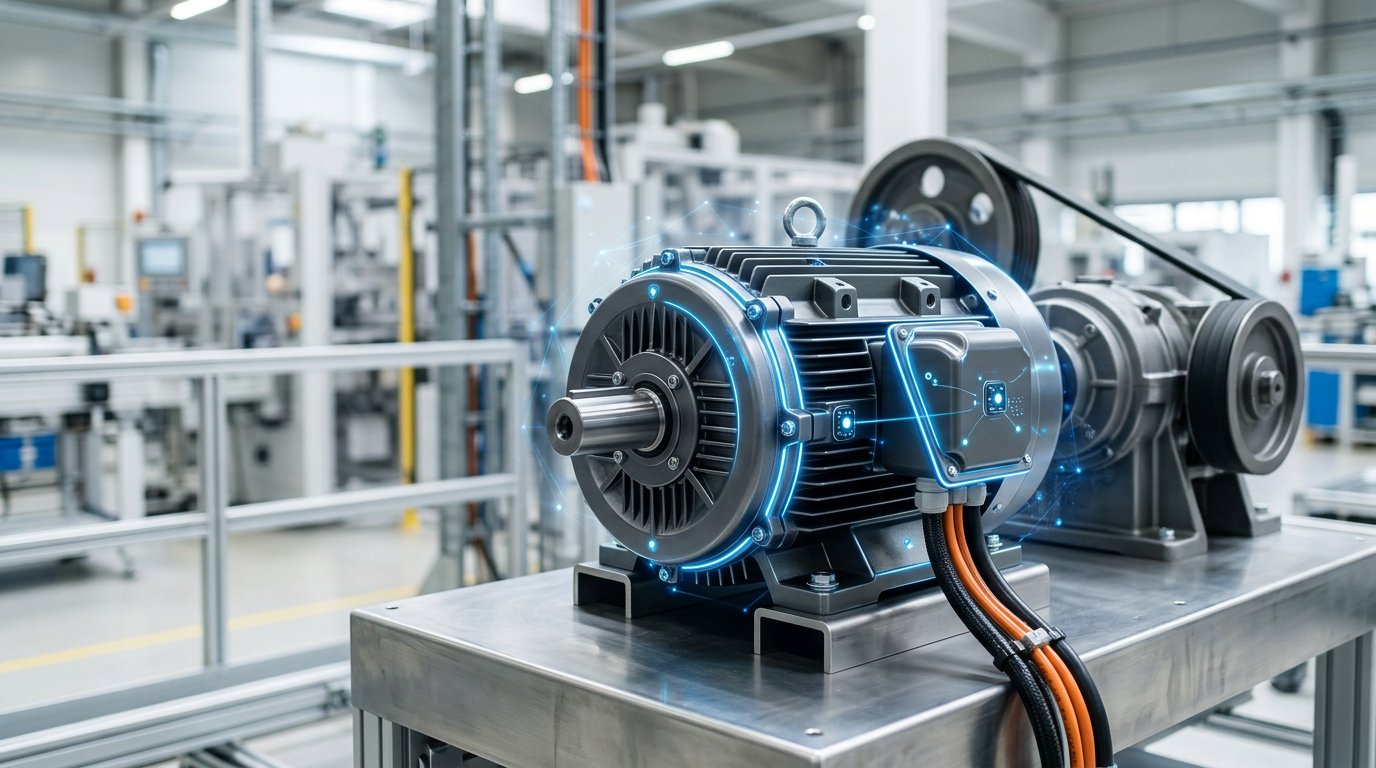
Most of the motors that keep factories, pumps and fans turning have one thing in common: they say nothing. They spin, they wear, and often the first sign of trouble is a stoppage. On November 24, 2026, ABB announced a motor built to change that. Intelleqt, which the company calls the world’s first low-voltage motor with intelligence integrated at the factory, is designed to deliver operational insight from its very first rotation.
The launch came at the SPS trade fair in Germany, and ABB framed it around a problem many manufacturers know well: artificial intelligence projects stall when the underlying equipment data is missing or unreliable.
What ABB announced
According to ABB’s group press release, Intelleqt combines factory-integrated sensing, edge computing and connectivity in a plug-and-play motor. Customers can connect the motor’s data to the digital platforms they already use, and ABB says an open architecture lets them keep full ownership of that data.
The idea is to turn a widely used piece of industrial equipment into a trusted data source without a separate retrofit project. Rather than bolting sensors onto an installed motor later, the intelligence ships inside it.
The data gap behind industrial AI
ABB points to a gap between AI ambition and results. Citing Deloitte’s AI in Manufacturing 2026 research, the release says 84 percent of manufacturers report benefits from artificial intelligence, yet only 20 percent of AI use cases have scaled. Data quality and availability remain among the main barriers.
Motors sit right in that gap. ABB, citing International Energy Agency figures, says more than 300 million motor-driven systems operate worldwide and account for 60 percent of industrial electricity demand, yet most are not connected to the digital tools used to improve reliability and efficiency. Data centers, water infrastructure and food production all depend on them. ABB also sizes the global IEC and NEMA low-voltage motor market at $18 billion.
Stefan Floeck, President of ABB’s IEC Low Voltage Motors division, put it this way in the release: most motors powering global industry do not generate data and remain invisible to the intelligence being built around them.
The claimed benefits, and their footnotes
ABB says turning motor data into actionable insight can help customers improve reliability, raise productivity and identify energy-saving opportunities of 30 percent or more, a figure it attributes to IEA material on industrial energy management. It also says early fault detection can cut unplanned downtime by up to 50 percent, citing McKinsey, and help avoid failures that cost up to $1.5 million per incident.
That last number comes with a stated assumption. ABB’s footnote uses a global median of $124,669 per hour of downtime and models one failure of a critical 110 kW motor in a factory, with 12 hours of downtime including removal, installation and commissioning. These are ABB’s illustrative estimates and third-party benchmarks, not measured results from Intelleqt installations, which are only now starting.
Availability and what comes next
Intelleqt is entering what ABB calls a customer co-creation phase, working with original equipment manufacturers and end users to shape solutions around their operations. A broader rollout is planned for 2027, initially in Europe, Japan, China and India. ABB did not give pricing or detailed technical specifications in the release.
The company also noted its research spending: it plans to invest 4.5 to 5.0 percent of group revenues in R&D, and it invested $1.3 billion in 2025, with roughly 7,800 R&D employees, about half focused on digital and software work.
What it means
For plant operators, the notable shift is where intelligence lives. Instead of treating condition monitoring as an add-on for the most critical machines, a factory-integrated approach could make data capture a default property of ordinary equipment. That matters most for fleets of many similar motors, where retrofitting each one is rarely worth the effort.
For equipment makers, the co-creation phase suggests ABB wants OEMs to build services on top of motor data. The open architecture and data-ownership message also speak to a common worry that connected equipment locks customers into a single vendor’s cloud.
The caveats are real. The headline savings and downtime figures are estimates, the product is early, and integration with existing platforms will decide how useful the data is in practice. Still, if the premise holds, the humble motor could become one of the most widespread sensors in a factory.
Conclusion
ABB’s Intelleqt is a bet that industrial AI will scale only when everyday machines start producing trustworthy data on their own. Over the coming months, the co-creation results with OEMs and end users will show whether built-in motor intelligence delivers on the promise.