
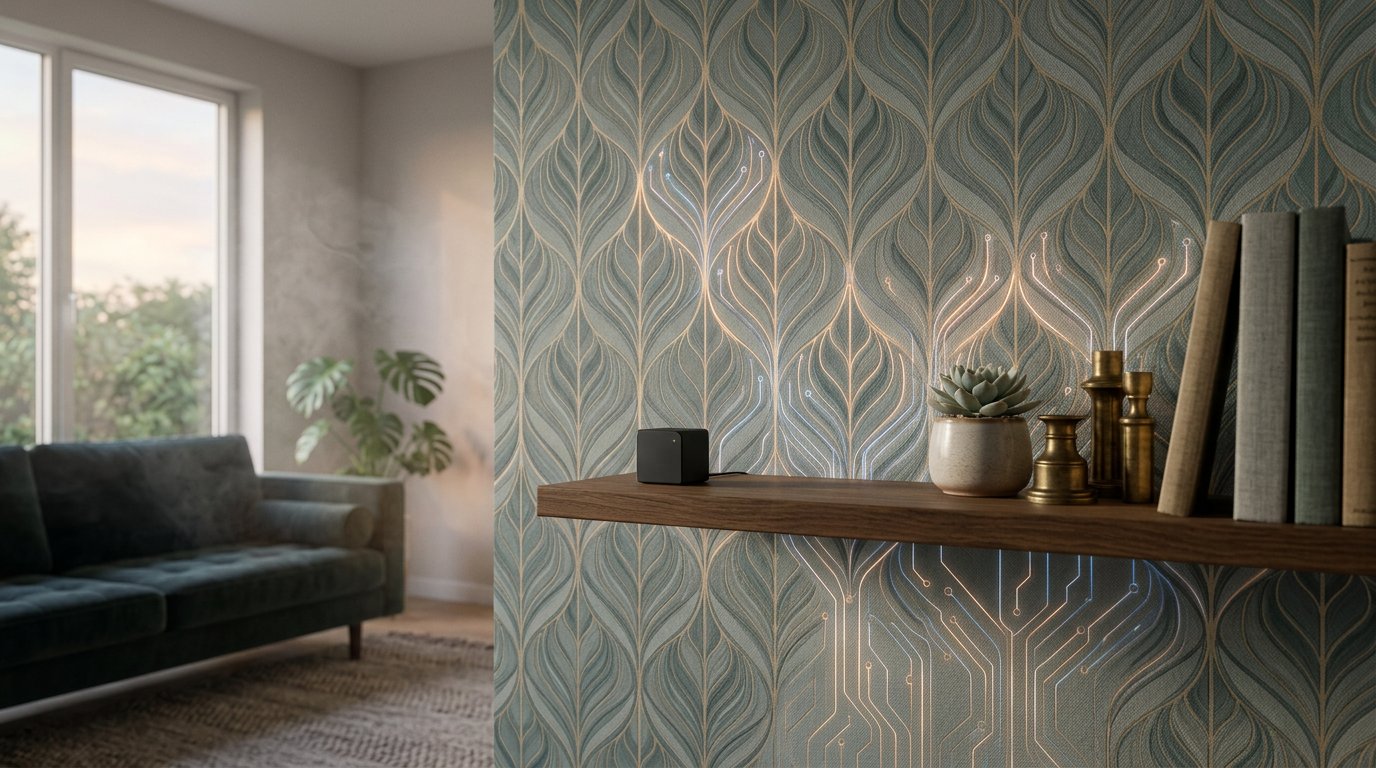
Rooftop solar is familiar. A wall that quietly makes electricity from the air in your living room is not. Researchers at Binghamton University in New York have built exactly that in prototype form: a wallpaper made of tiny moist-electric generators that absorb water vapor and turn the resulting ion movement into a small electric current.
The work was led by Professor Seokheun “Sean” Choi of the Thomas J. Watson College of Engineering and Applied Science, with PhD student Guangya “Roger” Yuan and Yang “Lexi” Gao, PhD ’26. It appears in the journal Advanced Energy Materials, and the details below come from Binghamton’s own announcement of the study.
How a moist-electric generator works
A moist-electric generator, or MEG, uses humidity as its fuel. Water molecules from the air are absorbed by a material that releases ions. Those ions move unevenly, which builds an ion-concentration gradient. That charge separation creates a voltage between two sides of the device, and connecting a circuit lets a small current flow.
Earlier MEG designs mostly targeted outdoor humidity, where there is plenty of moisture to harvest. Choi points out the catch: the power produced is tiny, and outdoor conditions swing with sunlight and weather. Indoors, humidity tends to sit in a steady band between 30 and 60 percent, and everyday activities such as breathing, cooking and bathing add more moisture to the air.
A layout borrowed from circuit boards
Most MEGs use vertical or horizontal stacks with an uneven mix of moisture-absorbing materials. The team notes that scaling those designs to wall-sized arrays wastes space and makes it hard to keep moisture flowing in one direction across a large area.
So they drew on Choi’s earlier papertronics work, which uses paper as a base for electronics, and arranged each generator like a microchip on a circuit board. Glycerol at the edges captures moisture from the air. A raised polyvinylpyrrolidone (PVP) structure in the center, patterned with a wax layer, controls how moisture is released and evaporates. That layout steers water from the absorbing region toward the evaporating region and keeps the gradient going for continuous generation.
Choi said combining three different regions on a single sheet of paper was not easy. His goal is for the whole thing to be printable, so it could be made at larger scale and eventually mass produced.
Designed to look like wallpaper
Nobody wants visible wiring on a bedroom wall, so the team put all the electrical connections on the back of the sheet. They also tested the generators wired in series and in parallel to see which gave more power. According to Binghamton, both arrangements produced similar results.
The announcement frames the output modestly. These arrays will not run a refrigerator. For now, Choi sees them powering small devices such as environmental sensors or wireless keyboards. The university also names wireless communication modules, smart-building interfaces and other Internet of Things devices that collect data as likely uses.
What it means
The appeal is less about generating kilowatts and more about removing small chores. Billions of low-power sensors are expected to sit in buildings, and each one normally needs a battery that someone has to replace. A surface that harvests ambient moisture could, in principle, keep a humidity or temperature sensor running without a battery swap or a power cable.
There is a second idea in the announcement worth noticing. Buildings spend a lot of energy on HVAC systems to pull moisture out of the air. Choi suggests that the same concept could help control room humidity while also generating electricity. That is a hypothesis from the researchers rather than a demonstrated result, and the announcement gives no power figures to judge how large the effect could be.
Readers should treat this as early-stage research. Open questions include how much power a square meter produces, how long the glycerol and PVP layers last, how the material behaves in very dry or very humid rooms, and what a printed version would cost. Binghamton says the team hopes to improve the technology for greater power yields.
Conclusion
Binghamton’s wallpaper is a small but imaginative step in energy harvesting: an indoor-friendly moist-electric generator designed to be printed, hidden behind a decorative surface and used for low-energy electronics. Whether it leaves the lab will depend on power output and durability, both of which the researchers are still working to improve.