
Finding a new material is often a story of waiting for computers. When chemists hunt for compounds that could superconduct or store energy in unusual ways, they may need to screen millions of candidates, and each one can demand heavy quantum-mechanical calculations. A team at California State University, Northridge (CSUN) says it has found a way to skip much of that wait. Their AI model, ELFNet, predicts a key chemical-bonding map 350 times faster than traditional physics simulations, according to the university’s November 17, 2026 announcement.
What ELFNet actually predicts
The model targets something called the electron localization function, or ELF. Chemists use ELF to turn the invisible behavior of electrons into three-dimensional maps they can read. Those maps highlight bonding regions, lone pairs, atomic shell structure and pockets where electrons gather between atoms. As CSUN explains in its release, ELF is widely used to identify chemically meaningful features in molecules and solids.
The catch is cost. According to chemistry professor Maosheng Miao, calculating the ELF for every metal lattice requires intensive, full quantum-mechanics calculations. That is manageable for a single material, he said, but modern science needs to screen millions of compounds, which makes traditional methods too slow to be practical at scale.
An image-to-image approach
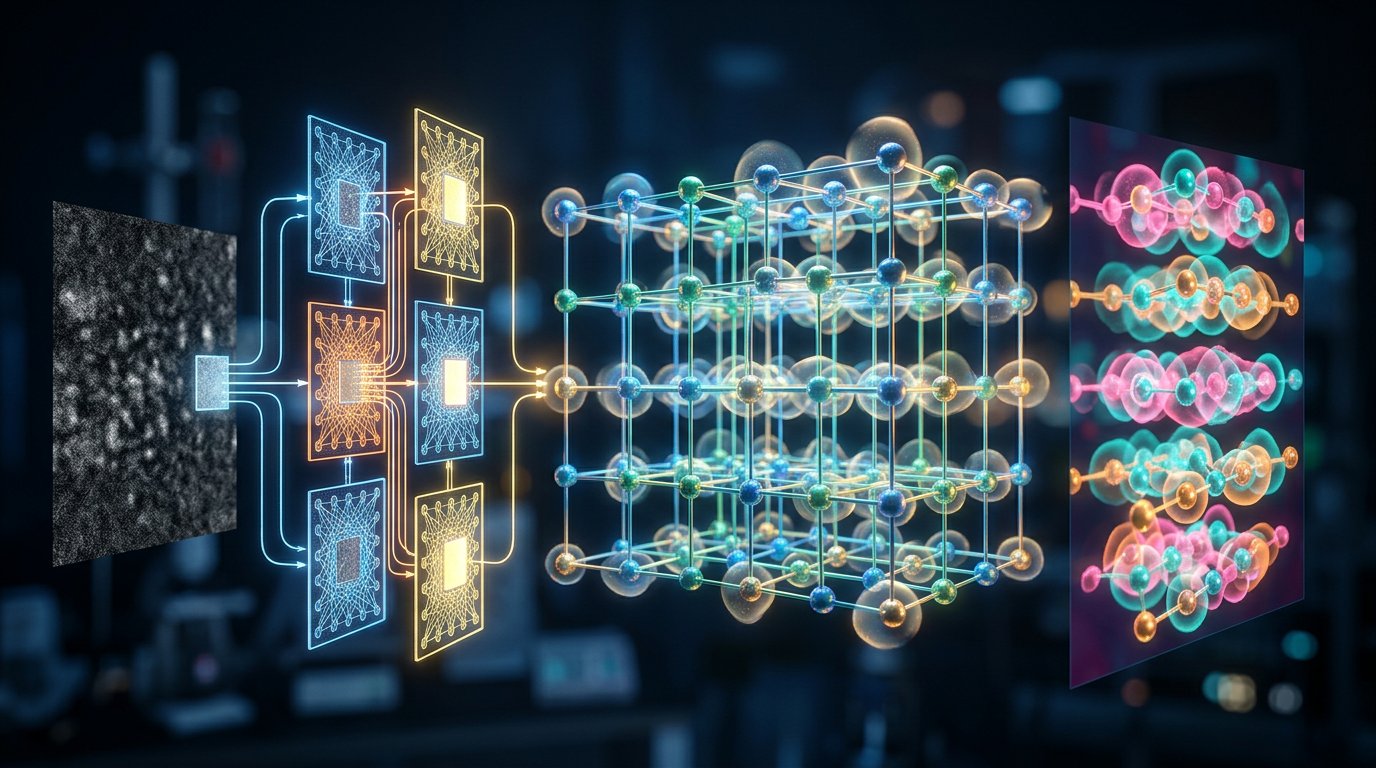
ELFNet treats the problem like image translation. Instead of starting from a real electron density, which is expensive to compute, the input is a cheap “superposed atomic density” made by simply adding together the densities of individual atoms. The network then converts that three-dimensional map into the ELF map showing where electrons become localized.
Under the hood, CSUN describes a convolutional neural network, a type of deep-learning model widely used to recognize patterns in images. The input passes through a series of processing blocks that progressively refine the prediction. Attention mechanisms help the model focus on useful patterns and regions, connections between layers carry earlier information forward, and the original spatial resolution is preserved throughout. The design is rooted in the quasi-atom and chemical template theories developed in the Miao Lab.
The work was led by Miao, whose lab studies how atoms and bonds change under high pressure. Co-authors include Austin Ellis, who earned a master’s degree in chemistry from CSUN last May and is now a researcher at Oak Ridge National Laboratory, and Samantha Ellis, a CSUN graduate student. Miao credited Austin Ellis with designing and building the network architecture with considerable independence.
Why superhydrides are the target
The team built ELFNet to speed up the discovery of superhydrides, high-pressure compounds with an exceptionally high hydrogen content. According to CSUN, these materials can conduct electricity without energy loss when cooled below a certain temperature. Discovering new ones is hard because researchers must evaluate many metal frameworks, hydrogen arrangements, compositions and pressures before promising candidates stand out, and that consumes expensive computer time.
Their paper, “Prediction of electron localization functions from superposed atomic densities for accelerated superhydride discovery,” appeared in the Journal of Materials Informatics and is the featured cover story of the journal’s most recent printed issue.
What it means
The headline claim is speed. Miao said ELFNet can reduce what could take months, if not years, of calculation to just days. Importantly, the model is positioned as a filter rather than a replacement for rigorous physics. In his words, by making these electronic fields available at low computational cost, ELFNet helps select promising metal templates for detailed first-principles calculations. Researchers would still verify the best candidates the slow way, but they would spend far less time on dead ends.
That pattern, a fast learned model that narrows a huge search space before expensive simulations take over, is becoming a common shape for scientific AI. It lets small university groups tackle screening problems that once required large computing allocations.
There is also room to grow. CSUN says the same image-to-image approach could be extended to predict charge density and wave functions, which would broaden its use beyond electron localization. As with any research result, the 350-times figure comes from the team’s own reporting, and independent use by other groups will show how well it generalizes to other compounds.
Conclusion
ELFNet is a modest-sounding project with a practical goal: make one of chemistry’s most useful maps cheap enough to compute for millions of materials. If it holds up in wider use, it could help point researchers toward the next generation of high-pressure hydrides sooner, and show how compact neural networks can take pressure off the world’s supercomputers.