
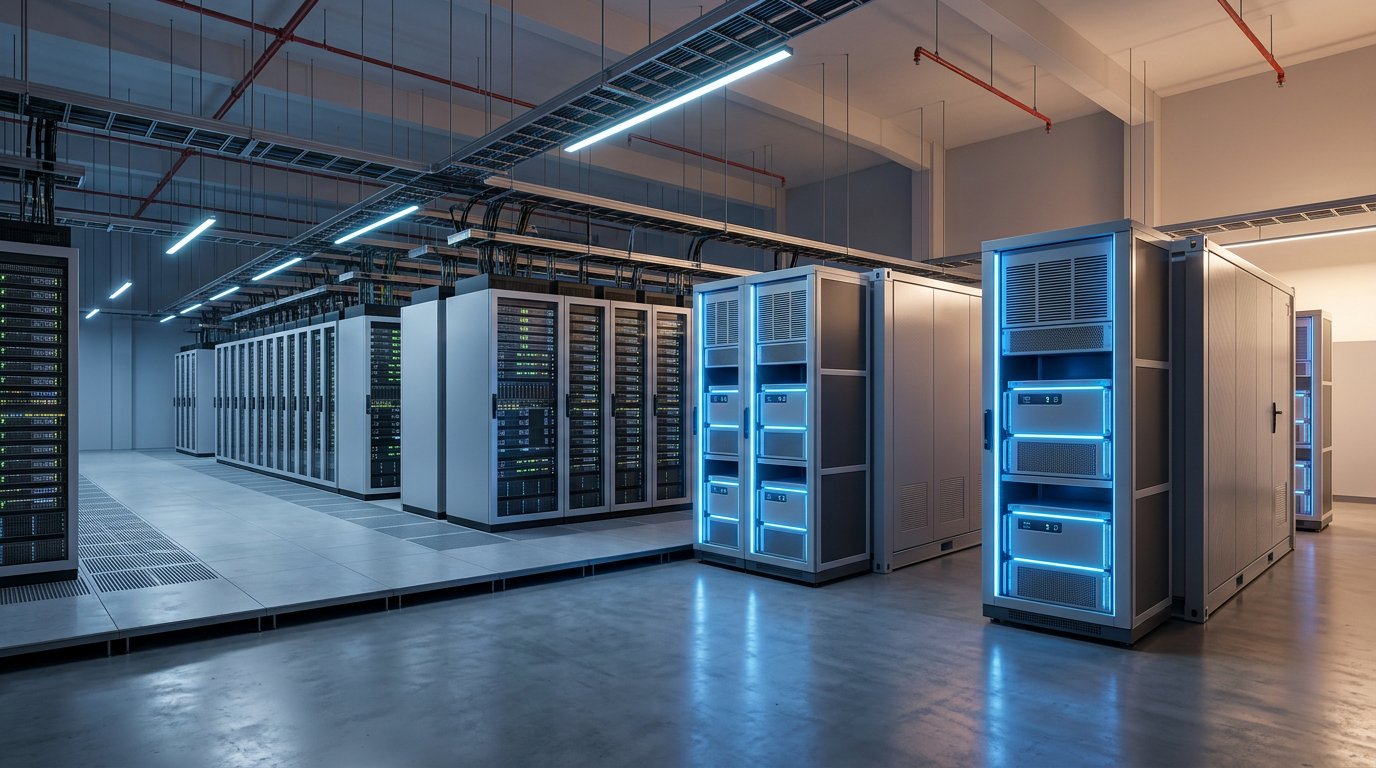
AI computing does not draw power politely. Training and inference clusters can swing from light to heavy load in fractions of a second, and the electrical systems behind them were not designed for that rhythm. On November 25, 2026, battery maker EVE Energy used RE+ 2026 in Las Vegas to launch a storage portfolio built specifically for AI data centers, which it calls AIDC energy storage.
Everything here comes from EVE’s own press release, so the specifications are the company’s claims. Still, the lineup shows how battery makers are repositioning storage from background backup to core data center infrastructure.
Three layers, one vendor
EVE organizes the portfolio into three layers: source-grid, power-distribution and cabinet-side. Together they are meant to cover needs from millisecond-scale load smoothing to long-duration energy management. The company says it can supply both cells and complete systems, drawing on its work across power, energy-storage and consumer batteries and its development of lithium, sodium and hydrogen technologies.
The pitch to customers is consolidation. EVE says a single-source offering simplifies procurement, gives clearer accountability because cells, battery management, system integration, thermal management and fire protection are developed within one architecture, and reduces operations and maintenance complexity through a common platform and one service contact. For facilities that run around the clock, fewer hand-offs between vendors is an appealing promise.
The headline products
At the grid side sits the S5-1P, a 20-foot container holding 5 MWh with 1P power capability. It uses a dedicated 315 Ah frequency-regulation cell with a volumetric energy density of 395 Wh/L. EVE reports no lithium plating at the cell interface under 1P charge and discharge or 1.22P frequency-regulation conditions, which it ties to safety and long service life in high-rate duty.
For transient, high-power loads, the Fortron backup cabinet supports continuous discharge at up to 10C and can deliver 660 kW for five minutes. It has a 15-year design life, works with UPS and HVDC systems, and uses a modular design that can be pre-integrated at the factory for quick deployment, with layered cell, thermal and fire-safety protections.
Smoothing power at the rack
The most granular layer is the rack-level BBU+CBU system, designed to smooth fluctuations across a window from 1 millisecond to 10 seconds. The battery backup unit uses lithium iron phosphate high-power cells in a dense 3U form factor and supports discharge rates up to 48C. Paired with it is an LIC hybrid supercapacitor that EVE says responds in 1 millisecond or less and is rated for more than one million high-rate pulse cycles. Autonomous system response is listed at 2 milliseconds or less.
The logic is straightforward. Supercapacitors take the fastest spikes, batteries handle slightly longer swings, and larger containers cover the grid-facing side. Splitting the job by timescale lets each technology do what it is best at, and it can keep fast AI load changes from rippling back into the wider power system.
What it means
As AI data center projects scale, power is turning into a limiting factor, and storage is moving from an optional extra to a design requirement. A portfolio that spans cells to cabinets signals that battery manufacturers want a seat at the table early, alongside the makers of UPS and power-distribution equipment.
For operators, the practical questions are interoperability and proof. Is a single-vendor stack worth the dependence on one supplier? How do the quoted response times and cycle lives hold up in live facilities? EVE also showed all-solid-state and sodium-ion technologies at the event, a reminder that the chemistry behind these systems is still evolving.
Conclusion
EVE Energy’s launch frames AI data center power as a layered problem with a layered answer. The numbers are company claims for now, but the direction is clear: fast, high-rate storage close to the rack is becoming as important as capacity on the grid side.