
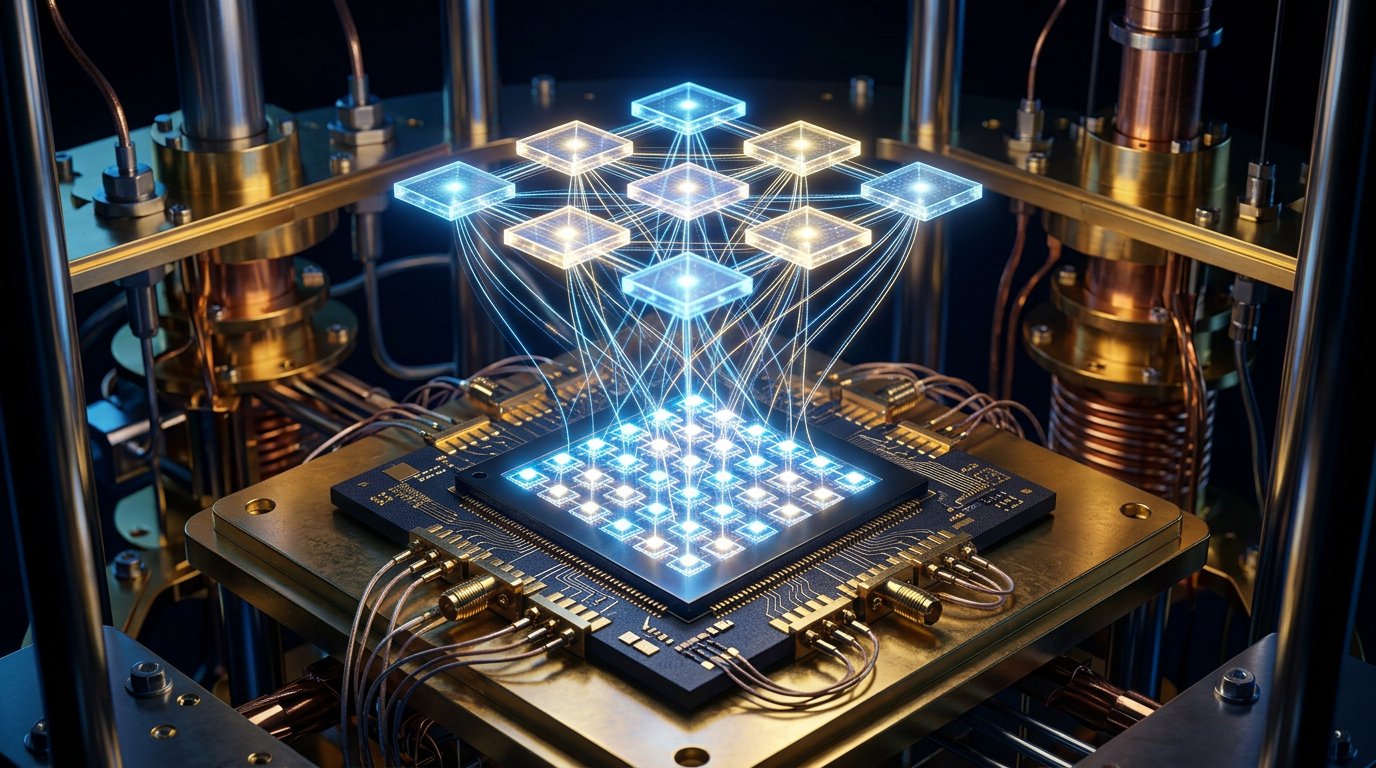
Entanglement usually gets the credit for what quantum computers can do. A new study from Google Quantum AI points to a quieter ingredient called contextuality, and shows it holds up on a real processor with more than a hundred qubits. The work was published on the cover of Science on November 19, 2026.
What contextuality means
In Google’s announcement, contextuality is described as a property in which a system’s measurement results are not fixed in advance. What you get from one measurement depends on which other compatible measurements you make alongside it, its “context.” Theory suggests this property may power certain quantum algorithms, but until recently it had mostly been shown in systems of a few particles.
The open question was whether contextuality survives in the many-body systems that real quantum computers are built from. The team’s paper, “Quantum-classical separation in bounded-resource tasks arising from measurement contextuality”, sets out to answer it.
A game that classical strategies cannot win
The researchers used the magic square game. Alice gets a row of a 3-by-3 grid and Bob gets a column. Each fills in entries of +1 or -1, following a rule that rows multiply to +1 and columns to -1, and they win if they agree on the shared square. No complete grid can meet both rules, so any pre-planned classical strategy loses at least one round in nine, capping the win rate at 88.89%.
On Google’s Willow processor, Alice and Bob each held two qubits that shared entangled pairs. Across all nine versions of the game, played 100,000 times each, the qubits won 98.30% of rounds. According to the team, that is well above the classical limit, and the gap is statistically significant.
Putting a number on it
Next, the team measured how contextual the machine is, using a Bell-Kochen-Specker inequality that bundles correlations into one value, called chi. Any world with predetermined outcomes must give a value of 4 or less, while quantum mechanics allows up to 6. The test works regardless of how the qubits are prepared, so it describes the machine, not a hand-picked input.
Measuring it took an extra helper qubit to read out each result without disturbing the two main qubits, and the run covered 540 measurements in a row, repeated 1,000 times. The result was 5.590 with an uncertainty of 0.008, above the classical bound and about 7% from the quantum limit.
Does it hold at scale?
The team then raised the stakes. In a GHZ parity game, up to 71 players, one per qubit, share an entangled state. The best classical plan wins 75% of the time for three players, and the rate drifts toward 50% as players are added. The qubits’ lead narrowed as noise grew, but stayed above the classical bound throughout. The researchers also verified genuine entanglement across 45 qubits.
They also ran a hidden linear function problem, which a 2018 theorem showed can be solved by a constant-depth quantum circuit but not by any constant-depth classical circuit. On grids of up to 105 qubits, success probabilities stayed above one-half, falling from about 1 to around 0.6 at the largest size, still above the conjectured classical bound.
A better ruler for hardware
There was a practical bonus. Because these tasks need many qubits to agree exactly, they surfaced subtle coherent errors that common random-circuit benchmarks tend to average away. The team argues contextuality can therefore serve as a benchmark: its ceiling, set by physics, never moves, so the gap between a machine’s score and the ceiling becomes an objective measure as processors improve.
What it means
For now, this is a fundamental-physics and hardware-evaluation result, not a product. It does not claim a useful application. What it offers is evidence that a property thought to underpin quantum advantage persists at scale, plus a sharper test for catching errors. Google notes that theory links contextuality to the “magic states” that error-corrected quantum computers need, which its team recently prepared with magic state cultivation. The team also says better benchmarks matter for future simulations of molecules and materials, where subtle errors cannot hide.
Conclusion
A nearly century-old debate about whether physical properties exist before they are measured now has a test that runs on a 105-qubit chip. Google Quantum AI reports that the answer, for its qubits, is clear: not everything we measure has a pre-existing value. The next question is how far this resource can be pushed toward useful algorithms.