
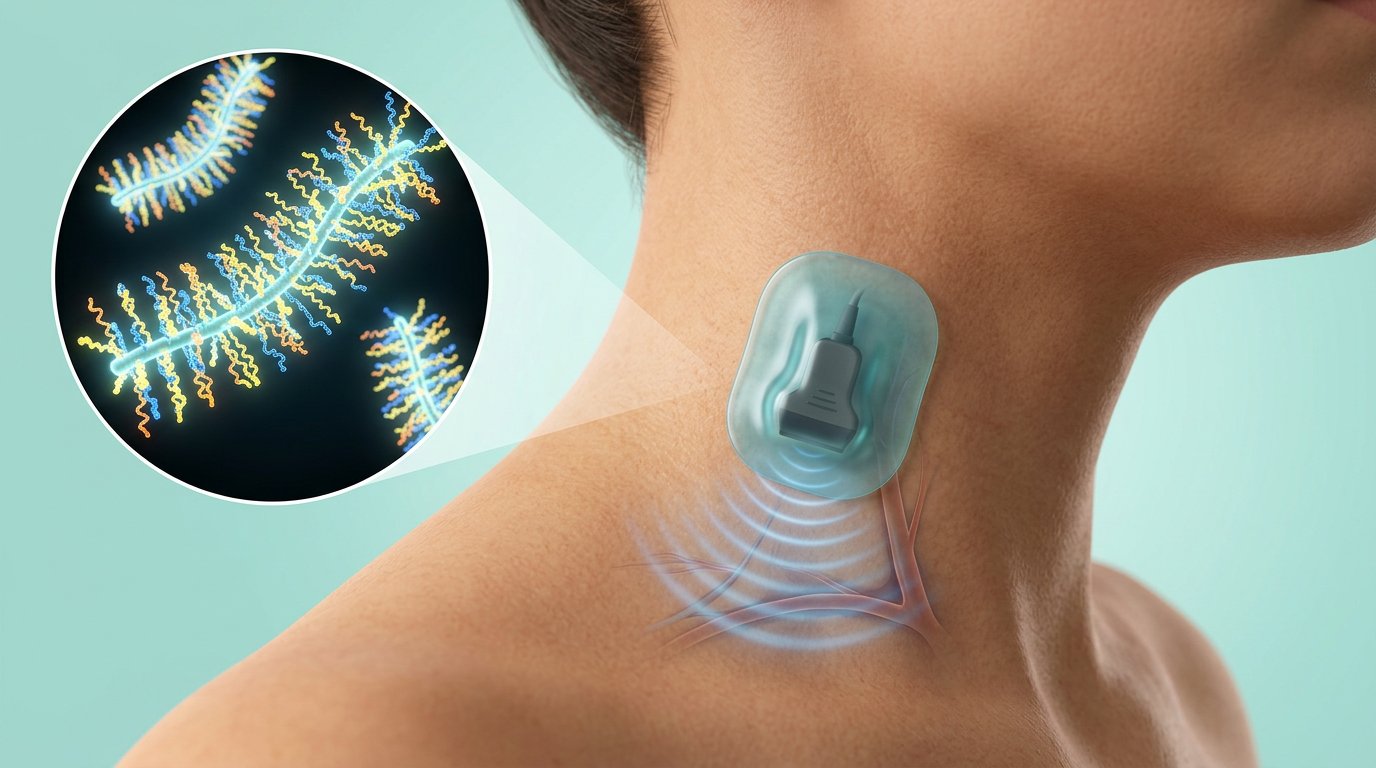
Anyone who has had an ultrasound knows the cold, sticky gel. It fills tiny gaps between the probe and skin so sound waves can pass through. For a doctor’s visit that is fine, but for a wearable patch meant to image continuously the gel is a weak link, because it dries out within a day or two. On November 19, 2026, MIT engineers and colleagues reported a dry, stretchy replacement in the journal Science.
What the team built
According to MIT News, engineers at MIT and the Singapore-MIT Alliance for Research and Technology’s Wearable Imaging for Transforming Elderly Care project (SMART WITEC) developed a liquid-free material that transmits ultrasound efficiently. Because it is dry from the start, its performance stays stable over long periods. In experiments, it let a wearable ultrasound device produce clear, continuous images for nine days, including during vigorous exercise.
The work comes from the lab of Xuanhe Zhao, a mechanical engineering professor at MIT. The study is led by postdoc Shu Wang, with co-lead author Runze Li, and the paper is titled “Interpenetrating Bottle-Brush Elastomer for Low-Loss Soft Ultrasonic Interfaces.”
The bottlebrush trick
Liquids carry sound well because their molecules slide past each other with little friction. Rubbery solids have long, tangled polymer chains that create friction and swallow the wave. The team tried to cut that friction without adding any liquid or lubricant.
Their answer was a bottlebrush molecular structure: a backbone with short side chains sprouting like the bristles of a pipe cleaner. Those hairy extensions do not easily penetrate neighboring molecules, so they move freely at ultrasound frequencies. The first samples built entirely from this architecture were very soft and crumbly, like tofu, as Wang described them.
The fix was to chemically fuse the first network with a second, loosely connected bottlebrush network. The second network holds the first in place without raising friction. The result is a tougher, rubbery material that the researchers could stretch repeatedly without tearing. Wang compares it to skin: soft, but it holds together when pinched or pulled.
How it was tested
The researchers made credit card-sized samples and first tested them on a phantom, a synthetic model that mimics skin and internal structures. The material passed ultrasound waves from a probe through the model and imaged the structures underneath, and it kept imaging clearly for around nine days of continuous operation.
To test mechanical performance, a patch was attached to a volunteer’s chest during a treadmill run, alongside a conventional silicone rubber sample. Over 10 minutes the silicone became water-logged with sweat, while the new material wicked sweat away.
In a field test, a key fob-sized patch with a small probe was fixed to a volunteer’s neck and connected to a portable tablet. Throughout a 30-minute bike ride with steep inclines, it kept imaging the rider’s blood flow continuously and accurately.
What it means
Wearable imaging has been held back by the interface between device and skin. “If you don’t have a good interface, that will definitely stop you from developing this wearable imaging field,” Li says. A durable dry layer removes one practical barrier and could make long-duration tracking more realistic, whether for athlete performance or monitoring outside clinical settings, which is what the team hopes to enable.
This is early-stage research, not a product, and the article reports no clinical use. The team says it is now working to streamline fabrication of the material. Questions such as manufacturing cost, skin comfort over long wear and regulatory steps were not addressed in the announcement. This coverage is news about research, not medical advice.
Conclusion
Sometimes a breakthrough is a better material, not a better gadget. By swapping gel for an engineered bottlebrush elastomer, the MIT and SMART team has shown a path to ultrasound patches that keep working for days. The next milestone is making the material easy to manufacture at scale.