
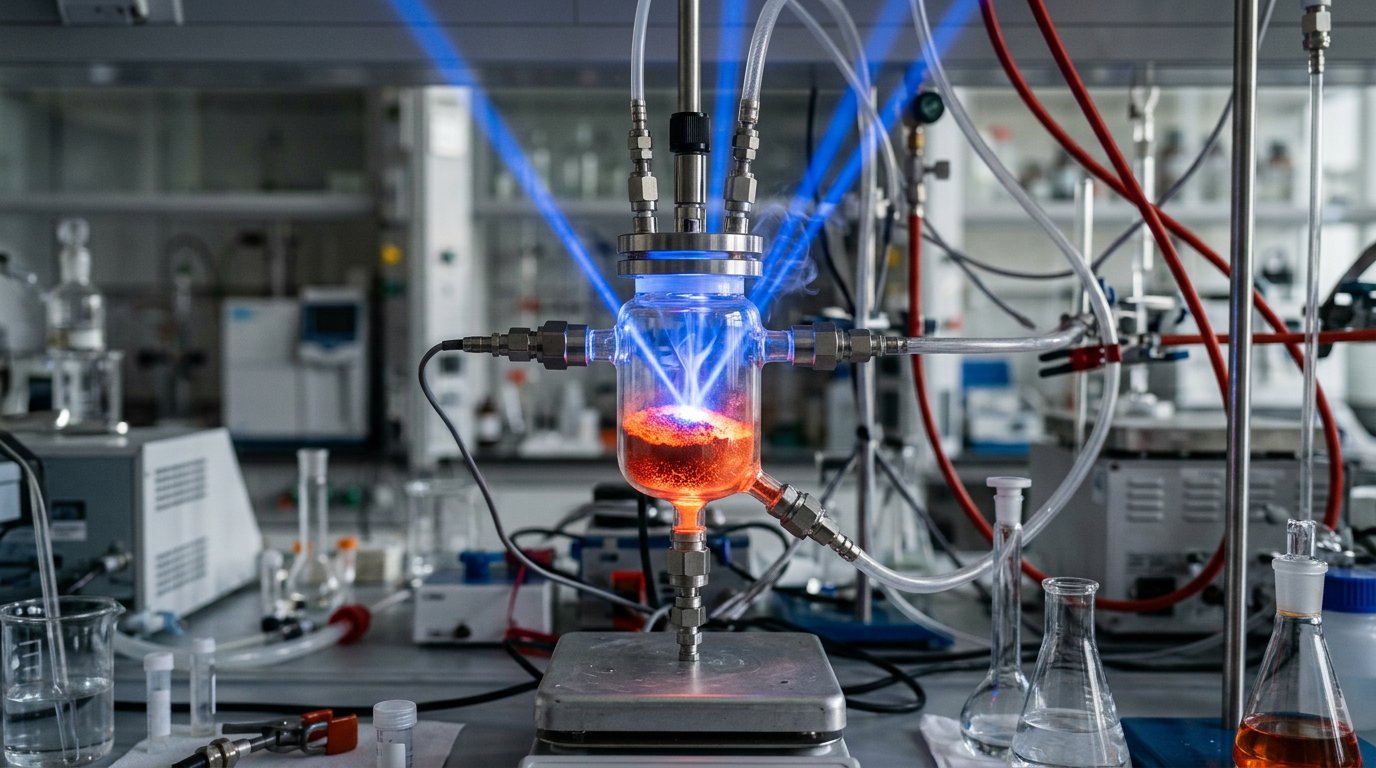
Carbon dioxide is one of the most stubborn molecules in chemistry, which is exactly why it is so hard to turn into something useful. Rice University researchers now report a way to split it using visible light at room temperature, a step toward recycling emissions into raw material for industry. The work was published in the Proceedings of the National Academy of Sciences and announced by Rice News on November 20, 2026.
The problem with splitting CO2
Conventional carbon dioxide conversion needs scorching industrial temperatures, between 700 and 1,500 degrees Celsius, or intense electrical discharges, and those routes often generate carbon emissions of their own. Earlier attempts at direct splitting ran into operating limits: the freed oxygen atoms quickly recombine with carbon monoxide, or they degrade the catalyst driving the reaction.
The prize for solving this is carbon monoxide, which Rice describes as a key raw material for synthetic fuels, plastics and everyday industrial chemicals. Converting waste carbon dioxide into that ingredient using light could give manufacturers a route toward net-zero production.
An antenna and an oxygen sponge
The team built a multifunctional material system. Light-harvesting copper nanoparticles are paired with cerium oxide, which Rice calls an “oxygen sponge” and likens to components used in automotive catalytic converters. When visible light hits the copper, the particles act as microscopic antennas that channel high-energy electrons into ruthenium reaction sites, breaking carbon dioxide into carbon monoxide and oxygen.
The cerium oxide then temporarily traps the freed oxygen in its crystal structure so it cannot recombine. The catalyst can be regenerated with nitrogen gas under light and used again. “Our approach makes it easy to break chemical bonds using light; however, that is not enough,” said senior author Naomi Halas. “The oxygen sponge properties of cerium oxide prevent the recombination of oxygen back to reform carbon dioxide.”
What the numbers show
Performance peaked under blue light at 475 nanometers, producing carbon monoxide at 15,000 micromoles per hour per gram. The light-driven process held steady production for 238 minutes, almost seven times longer than heat-driven controls, which degraded within 35 minutes. It also yielded nearly three times more carbon monoxide than test materials without the cerium oxide.
One detail stands out. Under laser illumination the catalyst surface reached 300 to 386 degrees Celsius, yet cooling the reaction chamber externally to 10 degrees Celsius raised carbon monoxide production further, because carbon dioxide molecules attached to the catalyst surface more effectively at lower temperature. Co-senior author Peter Nordlander explained that the electrons driving the reaction, which make up less than 0.05 percent of the catalyst’s mass, are heated beyond 10,000 degrees Fahrenheit even though the bulk stays far cooler. That is why he calls plasmonic photocatalysis a more energy-efficient approach than conventional thermocatalysis.
What it means
If the approach scales, it could change the economics of carbon reuse. “That shift could make carbon capture genuinely profitable,” Halas said, since captured carbon dioxide would feed directly into a valuable product. Rice notes the underlying antenna-reactor system has been licensed to Syzygy Plasmonics, a Houston clean-technology spinoff co-founded by Rice researchers, which is engineering light-driven reactors designed to scale the process with industrial lighting arrays. Hossein Robatjazi of Syzygy said the method, combined with modular photoreactors, could enable cost-effective carbon reuse across diverse industrial operations.
The caveat is the stage of development. The results come from laser-powered laboratory reactors, and Rice itself names the move to commercial-scale manufacturing as the next major milestone. Cost, durability over many cycles and performance under lamp arrays rather than lasers are still to be shown.
Practical takeaways
For readers tracking climate technology, this is a research result with a commercialization path rather than a product on sale. Useful signals to watch are scale-up pilots from Syzygy, long-run stability data and demonstrations with industrial light sources.
Bottom line
Rice’s copper-and-cerium catalyst splits carbon dioxide with visible light at room temperature, runs nearly seven times longer than heat-driven controls, and points toward turning emissions into feedstock. It is early, but it is a concrete step away from furnace-hot chemistry.