
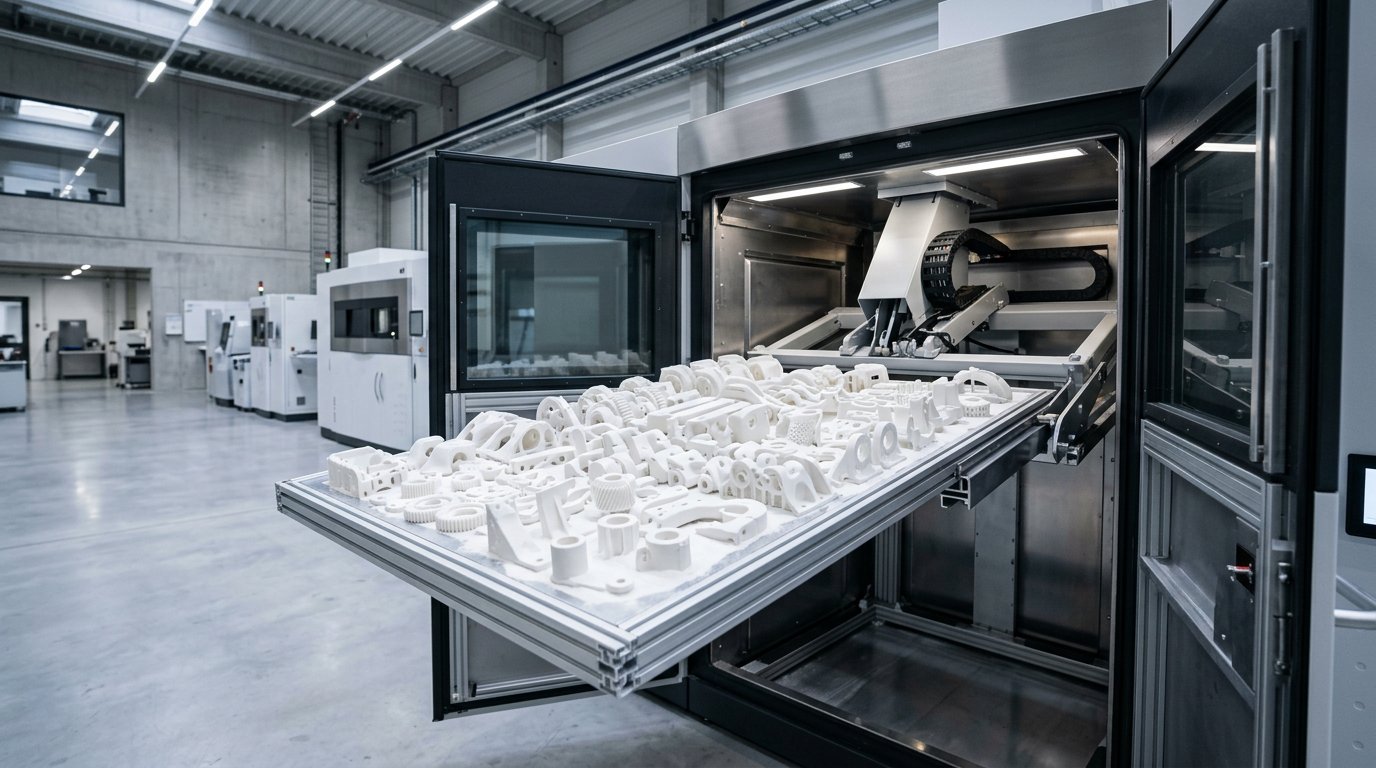
Industrial 3D printing keeps moving from prototypes to production parts, and the machines have to keep up. At Formnext 2026 in Frankfurt, Stratasys unveiled the H550, a larger powder bed fusion printer, along with an automated powder handling system called PowderEase T2. Here is what the company says it delivers, and what is still a claim.
A bigger build volume for bigger parts
According to the Stratasys press release, the H550 offers a 34.2-liter build volume and a 450 mm long axis. Stratasys says that is 20% longer than the leading comparable print-and-fuse system. The extra length lets manufacturers print larger single parts, such as UAV components, robotics and end-of-arm tooling, medical devices, automotive components, manifolds and ducts. The same volume can also hold hundreds of smaller parts in one batch.
The H550 builds on the company’s SAF (Selective Absorption Fusion) technology and sits beside the existing H350. Stratasys describes it as double the build capacity of the H350, so customers can choose a system based on application, production volume and part size. It also cites reduced infrastructure needs and a smaller footprint, which should make factory installation simpler.
Production economics
The cost claims are the headline. Stratasys says the H550 is designed to deliver up to 30% lower total cost of ownership than any other comparable print-and-fuse system on the market, with faster time to part than comparable SLS systems. These are company comparisons, and the release does not publish the underlying test data, so buyers will want to model their own cost per part before relying on them.
Rich Garrity, Chief Business Unit Officer at Stratasys, framed the system around decisions that shape a plant for years, saying the H550 pairs greater capacity and larger parts with economics designed to scale. Neil Hopkinson, VP of SAF and the inventor of the technology behind it, said the aim is the best available combination of part size, throughput and economics.
PowderEase T2 automates the messy part
Powder handling is one of the labor-heavy steps in powder bed fusion. PowderEase T2 automates breakout, powder retrieval, sieving and dosing for the H550. Stratasys says one station can support up to six H550 systems when they run the same material, and that the workflow needs under 30 minutes of total operator time per build. If that holds in practice, it reduces manual powder handling as shops add machines, and lets skilled operators spend more time on production tasks.
What it means
For manufacturers, the H550 is a sign that additive manufacturing vendors are competing on cost per part and labor, not only on what a printer can make. Larger builds matter for applications like manifolds, ducts and robot tooling, where part length decides whether printing is an option at all. Automated powder handling matters for shops that want to run several printers without growing headcount.
Timing is the caveat. Pre-orders opened on November 17, 2026, with commercial availability planned for Q2 2027, so independent results are months away. The system is on show at Stratasys’ booth in Hall 12.1 at Formnext, November 17 to 20, and a wait list is open on the Stratasys product page.
Conclusion
The H550 and PowderEase T2 target a simple goal: bigger parts, lower cost per part and less hands-on powder work. Whether the 30% figure survives real production will be the test to watch once machines ship next year.