Penn’s Self-Sensing Artificial Muscles Give Soft Robots Fine Control

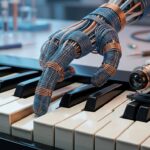
Robotic hand wrapped in blue and copper coiled fibers pressing piano keys next to a small mechanical eye module on a lab bench
AI-generated illustration A robotic finger presses a piano key, pauses, and moves on to the next note. Nearby, an artificial eye shifts its gaze through a series of small, controlled steps. According to Penn Engineering, both demonstrations rely on a new kind of artificial muscle that can sense its own state, hold intermediate positions, and coordinate with other muscles. The work, announced on November 12, 2026, comes from teams led by Shu Yang and Cynthia Sung. It is a small-scale stor...
More

MIT System- Learning spoken language

System learns to distinguish words’ and phonetic components without human annotation of training data. MIT researchers have developed a revolutionary new machine-learning system that can learn to distinguish spoken words and unlike its predecessors, it can also learn to distinguish lower-level phonetic units, such as syllables and phonemes. Every language has its own collection of phonemes, or the basic phonetic units from which spoken words are composed. The English language has somewhere...
More

Breakthrough technology for hearing impaired

MotionSavvy is putting forward a device to help the hearing impaired listen and speak. UNI, a sensitive tablet that interprets sign language and turns it into text and audible voice. There are plenty of things to take for granted in this life, and the ability to hear is one of them. MotionSavvy, is building a tablet case that leverages the power of the Leap Motion controller in order to translate American Sign Language into English and vice versa. The entire 6-person team is deaf. Known...
More