
Penn’s Self-Sensing Artificial Muscles Give Soft Robots Fine Control

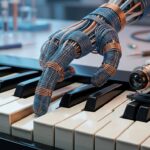
Robotic hand wrapped in blue and copper coiled fibers pressing piano keys next to a small mechanical eye module on a lab bench
AI-generated illustration A robotic finger presses a piano key, pauses, and moves on to the next note. Nearby, an artificial eye shifts its gaze through a series of small, controlled steps. According to Penn Engineering, both demonstrations rely on a new kind of artificial muscle that can sense its own state, hold intermediate positions, and coordinate with other muscles. The work, announced on November 12, 2026, comes from teams led by Shu Yang and Cynthia Sung. It is a small-scale stor...
More

MIT System- Learning spoken language

System learns to distinguish words’ and phonetic components without human annotation of training data. MIT researchers have developed a revolutionary new machine-learning system that can learn to distinguish spoken words and unlike its predecessors, it can also learn to distinguish lower-level phonetic units, such as syllables and phonemes. Every language has its own collection of phonemes, or the basic phonetic units from which spoken words are composed. The English language has somewhere...
More

Object recognition through flexible machine learning.

At the Annual Conference on Neural Information Processing Systems, MIT researchers will present a new way of doing machine learning that enables semantically related concepts to reinforce each other. Machine learning, which is the basis for most commercial artificial-intelligence systems, is intrinsically probabilistic. An object-recognition algorithm asked to classify a particular image, for instance, might conclude that it has a 60 percent chance of depicting a dog, but a 30 percent chance of ...
More