
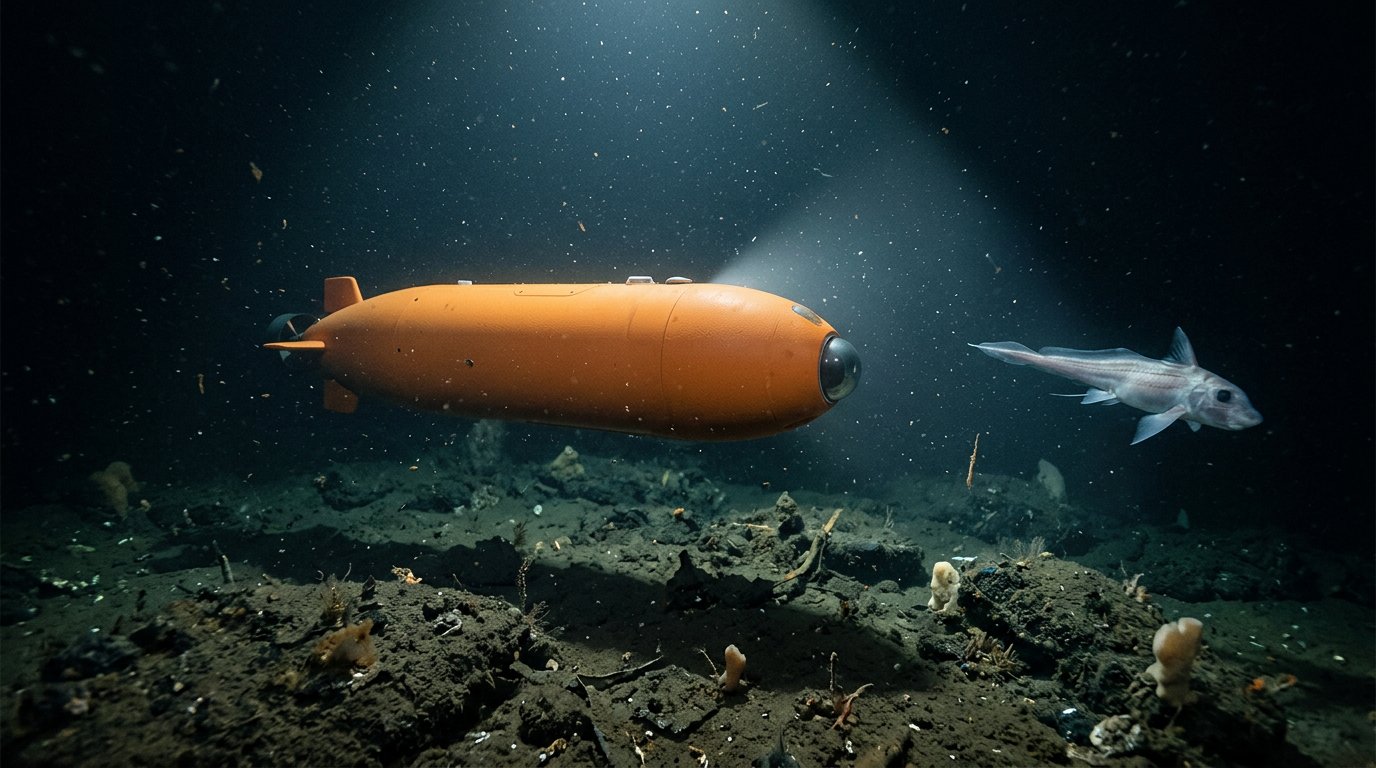
The deepest parts of the ocean are still among the least observed places on Earth, partly because reaching them has meant big ships, specialized crews and one-purpose machines. On November 20, 2026, the Woods Hole Oceanographic Institution (WHOI) announced a different approach: Deep Venture, a compact autonomous underwater vehicle (AUV) built with NASA’s Jet Propulsion Laboratory (JPL) that is rated for full ocean depth.
What Deep Venture is
According to WHOI’s news release, Deep Venture is a next-generation AUV for deep-ocean research that can support missions from shallow coastal waters to the deepest places on Earth. It is rated to 11,000 meters, about 6.83 miles. The release lists a weight of 250 kilograms (550 pounds) and dimensions of 72 inches long by 60 inches wide by 56 inches.
The design is deliberately lightweight, compact and modular. WHOI says the vehicle can be launched by a small team from a wide range of research vessels and then operate untethered and autonomously. That contrasts with earlier deep-sea AUVs, which the institution says were typically designed for specific missions and needed specialized equipment, support staff and access to a limited set of ships. The vehicle’s design was inspired by the chimera, a deep-sea fish.
What it can do on the seafloor
Deep Venture carries high-resolution imaging and photogrammetry, which supports detailed seafloor observation, mapping and 3-D reconstruction. It can also land on the seafloor, which opens the door to sample collection and other close-up work. A modular science payload bay lets researchers add new sensors and samplers, including chemical and biological instruments.
WHOI research engineer Allisa Dalpe said the vehicle can be reconfigured for different mission types with minimal changes, calling it a workhorse for oceanographic research.
A scouting partner for Alvin
One of the most interesting claims in the release is that Deep Venture is meant to work alongside other vehicles rather than replace them. During a June 2026 expedition near Bermuda it operated together with the human-occupied vehicle Alvin. Before an Alvin dive, Deep Venture descended roughly 6,000 meters and collected high-resolution seafloor imagery, which helped the Alvin team choose the most relevant places to dive.
Robin Littlefield, a senior engineer who leads the program at WHOI, said an AUV can survey an area in advance and give researchers information about where and how to deploy vehicles such as Alvin, which can improve dive planning and scientific value. The release describes Deep Venture as usable standalone or in coordination with human-occupied and remotely operated vehicles.
Where it comes from
WHOI says Deep Venture builds on the WHOI and JPL hadal research program, which ended with 13 autonomous dives as deep as 5,000 meters in the Gulf of Alaska in 2024, supporting Alvin science dives. With Deep Venture, the program moves to what the institution calls operational readiness. Littlefield added that WHOI envisions building more of these vehicles so researchers can cover more area or carry different payloads at the same time.
What it means
The practical story here is access. If a 250 kg vehicle can be handled by a small team and launched from many vessels, more research groups may be able to put instruments on the deep seafloor without booking a rare, heavily equipped ship. A modular payload bay also means one platform can be reused across biology, chemistry and mapping projects instead of building a new machine each time.
WHOI’s Anna Michel, chief scientist for the National Deep Submergence Laboratory, noted that better knowledge of the ocean gives decision makers a foundation for choices about exploration, resource use and environmental stewardship. The release also suggests the technology, which works autonomously in harsh conditions with limited communications, could inform future exploration of other extreme environments.
As with any new platform, the release describes capabilities and one expedition demonstration; it does not publish long-term operating statistics, so how often and how widely Deep Venture will be used remains to be seen.
Conclusion
Deep Venture pairs full-ocean-depth capability with a small, modular package and a team-player role next to crewed submersibles. If more vehicles follow, as WHOI hopes, deep-sea surveys could become faster to plan and easier to repeat.