
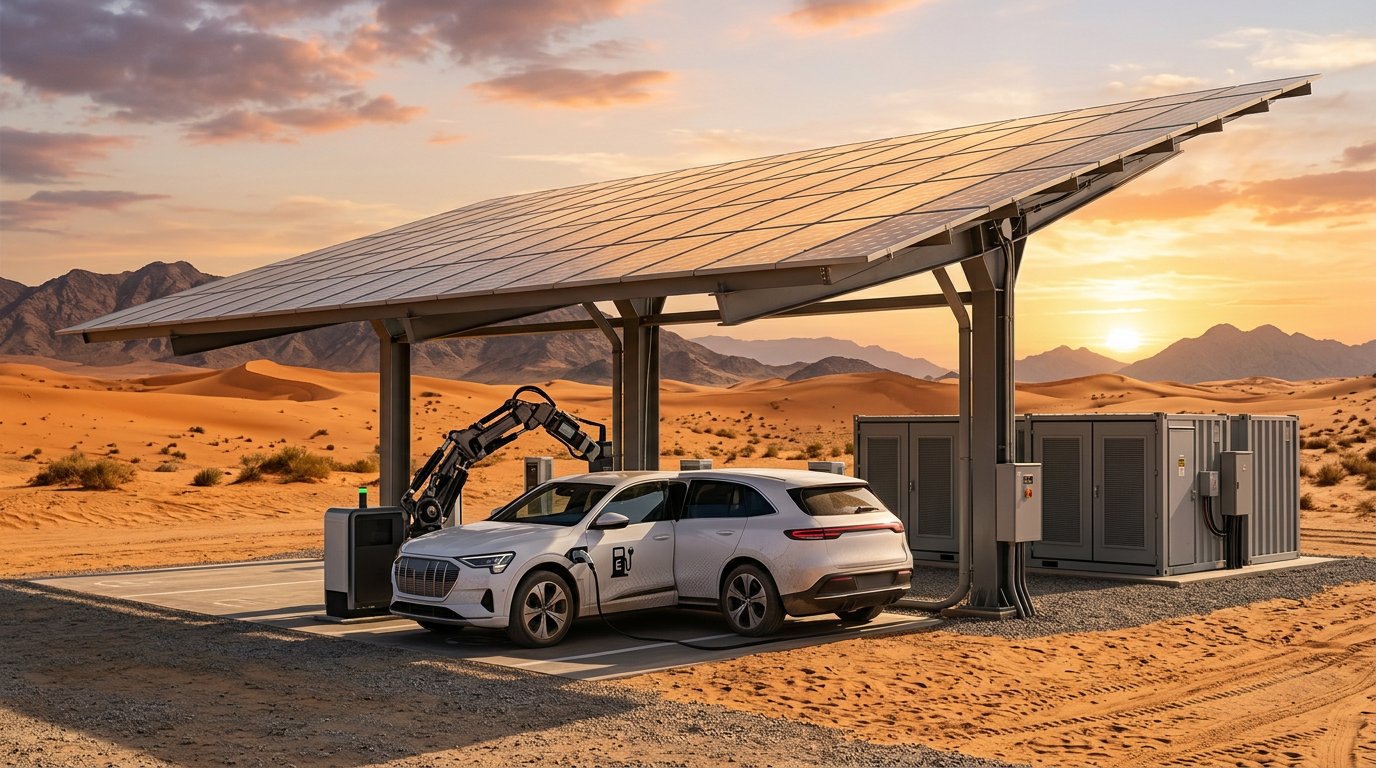
Picture pulling up to a charging site in the desert, stepping out, locking the car and walking away. The car drives itself to a bay, a robotic arm opens the charge port cover and plugs in, and the electricity comes from panels overhead and batteries beside the bay. That is the scene BYD described on November 10, 2026, when it announced an integrated charging installation in the Abu Dhabi desert.
This article draws on BYD’s press release on its UK media site. Claims such as “world’s first” are the company’s own.
Four technologies in one site
According to BYD, the installation brings together solar generation, energy storage, FLASH Charging and robotic charging in a single solution for the first time. Stella Li, BYD Executive Vice President, said the company is bringing its integrated Solar-Storage-FLASH Charging technology to the global stage, with the aim of making charging smarter, simpler and more seamless.
The site is built around BYD’s Solar-Storage-Charging (SSC) system, which links solar energy generation, battery storage and FLASH Charging so that solar energy can be captured, stored and used for vehicle charging as needed. BYD says its solar business has more than 16 years of experience, serves customers in over 100 countries and regions, and has an R&D team of more than 300 specialists and over 200 technology patents.
How fast is FLASH Charging?
BYD states that FLASH Charging can take a vehicle from 10% to 70% in five minutes and from 10% to 97% in nine minutes, bringing charging closer to the time of conventional refuelling. The release does not give the site’s charging power in kilowatts or name the vehicle used, so those details are not confirmed by the primary source.
Independent of the grid
The most interesting engineering point is the pairing of solar panels with battery storage. BYD says this lets the SSC system operate independently of the electricity grid, reducing dependence on existing power infrastructure and giving more freedom about where charging can be built, including places where grid access is limited. The desert setting, BYD notes, also shows the system working in intense sunlight, high temperatures and scarce rainfall. The release does not disclose how much energy the batteries store or how much solar capacity the site has.
A robot that plugs the car in
The robotic part removes the last manual step. BYD says the arm automatically locates the charging port, opens its cover and inserts the connector, using visual guidance and force feedback to align accurately and connect securely to the FLASH Charging system.
BYD links this with Automated Valet Parking. Drivers can exit and lock the vehicle, then the car navigates itself to a designated charging space. Once it is parked, the robotic arm connects it without the driver touching the cable. The company argues this helps when drivers are in a hurry or facing extreme outdoor temperatures, extending automation from driving and parking to charging itself.
What it means
For fleet operators and site developers, the combination is a template: generate power on site, buffer it in batteries, and deliver it quickly with no human labour at the plug. It could matter for remote highways, depots and hot regions where grid upgrades are slow or costly. For drivers, the robot arm is mainly about convenience, and it also points toward charging for self-parking vehicles.
The release frames the site as part of a wider rollout: BYD plans 6,000 FLASH Charging stations worldwide by the end of 2027. It does not say how many of those will include solar, storage or robots, nor when or whether the Abu Dhabi site opens to the public. It also says nothing about pricing. Those gaps are why this reads as a demonstration of capability rather than a commercial product launch.
Conclusion
BYD’s Abu Dhabi installation shows how charging, clean power and automation can be designed as one system instead of separate purchases. The proof points to watch are public availability, real-world charging power and whether the grid-independent design can be repeated at scale.