
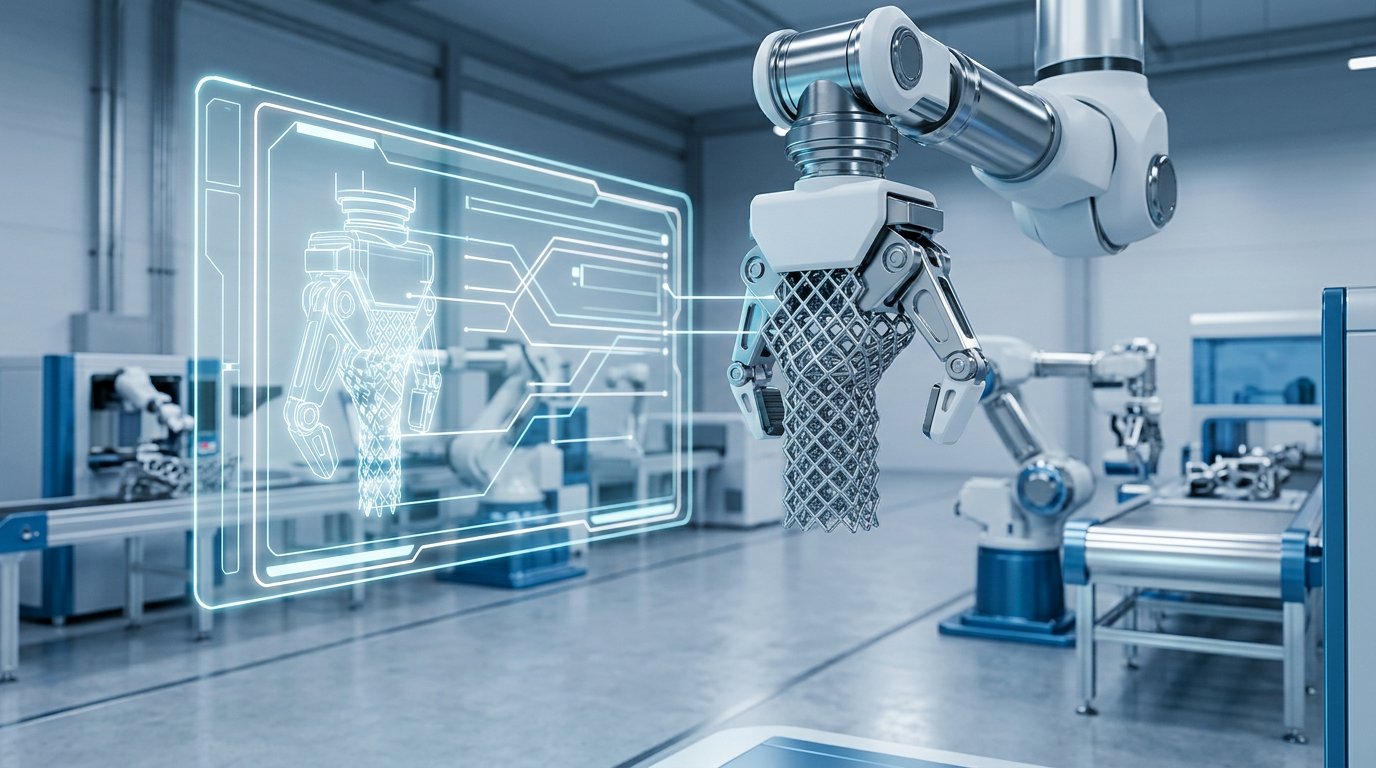
Designing a custom robot gripper normally means a human engineer tweaking geometry, running simulations and preparing files for a 3D printer, step by step, for every new job. Siemens now says an AI agent can orchestrate much of that chain from a plain description of the task. In a November 16, 2026 press release, the company laid out an end-to-end digital thread that links prompt-based engineering to an adaptive additive manufacturing production cell.
The details below come from Siemens’ own announcement, so they describe the company’s demonstration and plans rather than independently verified results.
From a description to a printable gripper
Working with AGIBOT, Siemens demonstrates the idea using a gripper for a humanoid robot. Instead of adapting the gripper manually for each application, a user first describes the object to be handled and the task. An agentic AI workflow then handles the engineering steps: it selects a suitable gripper type, adapts the geometry in Siemens’ Designcenter, simulates it, and validates the robot interface and handling. Finally it prepares the data for additive manufacturing.
Siemens says the AI agent reaches the engineering software’s functions through MCP integration. The result, according to the company, is a gripper tailored to the application, virtually validated and ready for printing before production begins.
An adaptive production cell in Erlangen
Design flexibility only helps if production can keep up. Siemens is therefore extending the approach into manufacturing with an adaptive production cell for additive manufacturing. Together with EOS and AM Solutions, it is creating the environment at its Electronics Factory in Erlangen, where printing, automation, post-processing and software are designed to work as one integrated process chain.
The release stresses that post-processing is part of the cell from the start. David Soldan of AM Solutions said the industrialization of additive manufacturing does not end with the printing process, and that downstream steps must be integrated for parts to be made efficiently and reproduced at scale. The cell is described as planned, not yet finished.
Data as the glue, and a way to start
Siemens argues that integrated software and data chains connect design and simulation with manufacturing preparation, production and operations, and that industrial AI can use that data to link the steps. It adds that quality, traceability, security and human responsibility remain key requirements for industrial deployment.
For companies not ready for a full digital thread, Siemens highlights its AM I Navigator, now enhanced with Industrial AI. It helps identify and prioritize applications in design, engineering and production, then define pilot projects and a roadmap for scaling.
What it means
The interesting shift is who can do the engineering. Siemens says prompt-based workflows can make complex engineering accessible to a broader group of users by reducing the need to operate each tool and process step directly. Combined with 3D printing, which can turn one-off designs into physical parts, that points toward small-batch, application-specific tooling made on demand.
The caveats are real. The gripper is a demonstration, the production cell is still being built, and the release offers no performance, cost or time-saving figures. Karsten Heuser of Siemens framed the production side as the next step, saying the goal is production that can respond just as flexibly to design variety.
Bottom line
Siemens is betting that agentic AI plus additive manufacturing can make custom industrial parts a routine request instead of an engineering project. The company will present the humanoid gripper workflow at Formnext 2026 in Frankfurt, where more detail should emerge.