
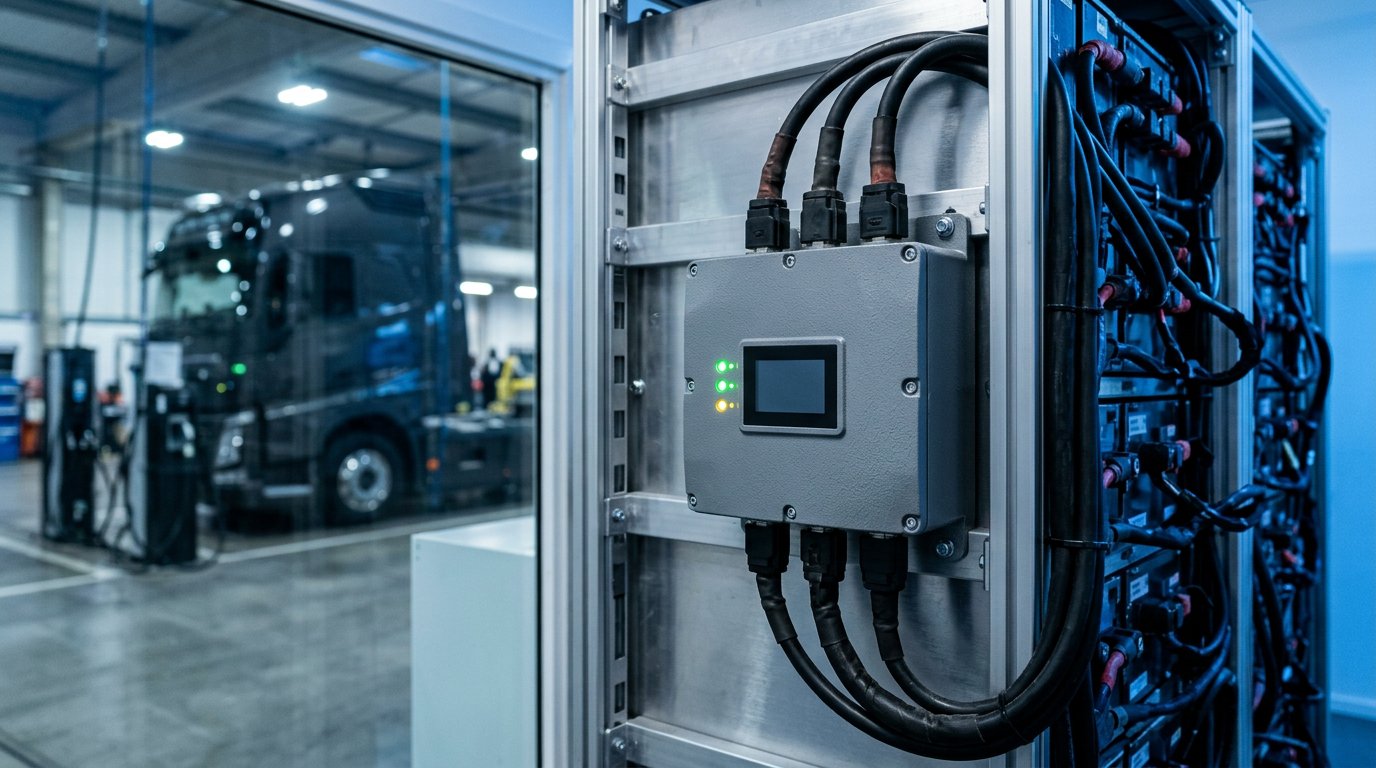
Every battery storage site, megawatt truck charger and solar-plus-storage microgrid has to switch large direct current on and off safely. That job is harder than it sounds, because DC current has no natural zero crossing and tends to leave a stubborn arc behind when contacts open. On November 20, 2026, Siemens announced what it calls the world’s first semiconductor-based heavy duty DC contactor, the SIRIUS 3QC1, built for up to 1,500 V and 600 A.
What Siemens announced
According to the Siemens press release, the SIRIUS 3QC1 combines semiconductors with mechanical contacts in a hybrid design. It offers galvanic isolation and what the company describes as reliable, wear-free switching of high DC loads. The device is meant to complement Siemens’ existing direct current portfolio and help customers adopt DC grids more quickly.
The contactor will come in four current ratings: 300 A, 400 A, 500 A and 600 A. It runs on a 24 V DC control voltage, works in temperatures from -25 °C to +60 °C and tolerates up to 95 percent humidity. A compact housing includes an integrated display with status and condition LEDs, and the unit can be switched remotely, which removes the need for someone to operate it by hand on site.
How the hybrid design works
The idea is a division of labor. The semiconductors handle the actual switching moment precisely and without wear, which prevents arcing. While the device is in operation, the mechanical contacts stay closed and carry the current with low losses. Because the contacts are not forced to break a loaded circuit, they avoid the erosion that shortens the life of conventional designs.
Siemens says this combination gives the contactor a durability of at least 150,000 switching cycles. The mechanical contacts also provide true galvanic isolation, so when the device opens, the conducting path is reliably interrupted rather than just throttled by electronics.
Another notable feature is bidirectionality. The SIRIUS 3QC1 switches independently of current direction, which suits systems that both charge and discharge, such as battery energy storage systems. Siemens positions it for standard 100 kW power racks and for high-power racks of up to 375 kW at 300 A and 1,500 V.
Where it could be used
The press release lists several target applications. In stationary storage, the contactor can sit inside battery racks. In e-mobility, it can support megawatt fast-charging stations for fleets, e-trucks and e-buses, with power ratings up to 1,000 kW. It also suits marine installations on ships and industrial DC microgrids that couple photovoltaic generation with storage, helping sites stay independent when the AC grid fails.
Siemens pairs the device with a fuse in what it calls a simple, cost-effective and familiar design. Because the switching is wear-free, the company says the device is durable and maintenance-free, which should lower a plant’s maintenance costs along with its initial investment.
Why direct current matters
The announcement rests on a broader case for DC systems. Siemens cites up to 8 percent energy savings from reducing AC-DC conversions, plus direct integration of renewables and battery storage. It also points to savings of up to 50 percent on materials, since DC systems can use cables with a smaller cross-section and need fewer conductors and components.
Markus Grabmeier, President Electrical Products at Siemens AG, called the shift to direct current a gamechanger for energy efficiency and renewable integration, describing the new contactor as a building block of that transition. These are the company’s own figures and claims, and real-world savings will depend on each installation.
What it means
Switching hardware rarely makes headlines, yet it quietly limits how fast DC infrastructure can grow. Battery sites and fast chargers need components that can open and close under heavy load thousands of times without degrading. A solid-state-assisted contactor that avoids arcing could reduce service visits and make compact, remotely controlled racks easier to design.
It is also a reminder that the energy transition is as much about plain components as about batteries and panels. Engineers planning storage or charging depots now have another option to compare against traditional DC breakers and contactors, though pricing and availability details were not part of the announcement.
Siemens plans to show the contactor publicly for the first time at the Smart Production Solutions trade fair in Nuremberg, Germany, from November 24 to 26, 2026, at its booth in Hall 11.
Conclusion
The SIRIUS 3QC1 is a modest-looking box with a big ambition: make high-voltage DC switching durable, compact and maintenance-free. If it delivers the 150,000 cycles Siemens promises, it could become a quiet enabler of storage, charging and microgrid projects. The trade fair debut should give buyers a first hands-on look.