
Soft tissue moves, stretches and slides the moment a surgeon cuts it, which is exactly why handing a scalpel to a machine is so hard. A Johns Hopkins team now reports a robot that kept track of those changes and removed tumors from eight lab-made kidneys, making 77 cuts without a single error.
The result, announced by the Department of Mechanical Engineering on November 9, 2026, is a research milestone in a controlled setting. The kidneys were synthetic gel models, not patients, and the wor...
More
tumor tracking
Supercoiled DNA is far more dynamic than the “Watson-Crick” double helix
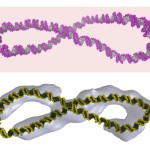
Researchers have imaged in unprecedented detail the three-dimensional structure of supercoiled DNA, revealing that its shape is much more dynamic than the well-known double helix.
As reported online today in the journal Nature Communications, the simulations also show the dynamic nature of DNA, which constantly wiggles and morphs into different shapes, a far cry from the commonly held idea of a rigid and static double helix. Improving our understanding of what DNA looks like when it is in the...
More
Live imaging reveals how wound healing influences cancer

"See-through" larvae of zebrafish reveal how wound healing leads to skin cancer.
Genetically modified larvae of zebrafish were studied by the researchers in the United Kingdom and Denmark to watch the relationship between wound-associated inflammation and melanoma.
The cellular events and changes were observed by live imaging with a special confocal laser-scanning microscope.
The experiments showed that neutrophils, the protective inflammatory cells of the body's immune system, gets d...
More