Robbyant Open-Sources LingBot-Map 2.0 and LingBot-Navi

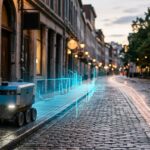
Small wheeled delivery robot on a cobblestone street with a glowing 3D map trailing behind it and a route ahead
AI-generated illustration A robot that wanders a city for several kilometers builds up small mistakes, and by the end its map no longer matches the street. Then, once the job is done, it forgets everything and starts from scratch next time. On November 27, 2026, Robbyant, the embodied AI company within Ant Group, announced the open-source release of two models aimed at exactly those two problems: LingBot-Map 2.0 and LingBot-Navi. Fixing the map from the inside LingBot-Map 2.0 is a str...
More

Recording Videos for Physical AI Training: Inside Objectways

A person wearing a head-mounted camera folds laundry in a home-style studio while a white faceless humanoid robot stands near the kitchen counter
AI-generated illustration: recording household tasks on camera so robots can learn them Large language models learned to write by reading the internet. Robots have no such library. To learn how to fold a shirt, screw on a bottle cap or stack plates without smashing them, they need to watch people do it, thousands of times, from angles that match a robot’s own eyes and hands. That has created a new kind of work: recording videos for physical AI training. One of the companies doing i...
More

Aptiv PRISM ADAS Aims for Hands-Free Driving at Half the Cost

Aptiv PRISM ADAS Aims for Hands-Free Driving at Half the Cost - editorial illustration
AI-generated illustration Driver-assistance software is getting smarter, but the price of the hardware and software around it decides how many cars actually get it. On November 19, 2026, supplier Aptiv announced PRISM, an ADAS platform that it says delivers performance comparable to industry-leading hands-free driving systems at half the cost. What Aptiv announced In its press release, Aptiv describes PRISM, short for Perception & Reasoning for Intelligent, Safe Mobility, as a co...
More

Vision-Language Models 2026: Gemma, DINOv3 and 8 More Compared

3D illustration of a camera lens sending glowing image tiles through a connector into a neural network that forms blank speech bubbles
AI-generated illustration Ask a modern AI model to read a scanned invoice, find the dent in a photo of a car door, or tell you when the forklift first appears in a two-hour warehouse video, and there is a good chance it will manage. That everyday trick is the work of vision-language models, or VLMs: systems that take pictures and words in together and answer in words. By late 2026 the field has split into a crowded open-weight camp and a handful of frontier cloud services, with specialis...
More

Moon Surgical’s Maestro Brings Physical AI to Surgery

Robotic surgery has long meant a large console, a dedicated room and a price tag that keeps it out of many operating rooms. Moon Surgical, a company based in Paris and San Francisco, is betting on a different shape for the technology: two compact robotic arms that sit at the bedside, hold the laparoscope and a retractor, and let the surgeon keep using the instruments they already know. Over the past eighteen months the company has turned that idea into something larger, an AI platform that ...
More

JHU Robot Removes Kidney Tumors From Gel Models on Its Own

Soft tissue moves, stretches and slides the moment a surgeon cuts it, which is exactly why handing a scalpel to a machine is so hard. A Johns Hopkins team now reports a robot that kept track of those changes and removed tumors from eight lab-made kidneys, making 77 cuts without a single error. The result, announced by the Department of Mechanical Engineering on November 9, 2026, is a research milestone in a controlled setting. The kidneys were synthetic gel models, not patients, and the wor...
More

MIT’s UQ-DAAAM Helps Robots Fix Their Own Wrong Memories

Picture a robot sent to fetch a wall-mounted defibrillator. If its stored memory wrongly lists that object as a fire extinguisher, it may never find the device. That example opens an MIT News report, published November 5, 2026, on a new system that lets a robot notice when its own memory might be wrong and repair it. The system is called UQ-DAAAM, short for Uncertainty Quantification for Describe Anything, Anywhere, at Any Moment. It was developed by researchers at MIT, led by associate pro...
More

CMU’s ESTIMATA-EX Uses Phone Photos to Estimate Surgical Blood Loss

In many operating rooms, one of the most important numbers is still an educated guess: how much blood has the patient lost? Chiang Mai University in Thailand says it has built an AI system to replace that guess with a measurement. In a university announcement dated 2 November 2026, the team introduced ESTIMATA-EX, which estimates blood loss and counts blood-soaked surgical materials from photos taken on a smartphone or tablet. This article covers the announcement as news and is not medical ...
More

Skyscraper Uses Built-In Wind Turbines for Energy

Bahrain is the home of the first skyscraper to have wind turbines integrated into the structure of the building. The Bahrain World Trade Center is a 50-story twin tower complex containing two identical towers that rise over 240 meters in height. The sail-shaped buildings offer a visually striking image and boasts of one its very unique feature which is the 3 giant wind turbines tying the two “sails” together. It is the first skyscraper in the world to integrate wind turbines into its desig...
More