
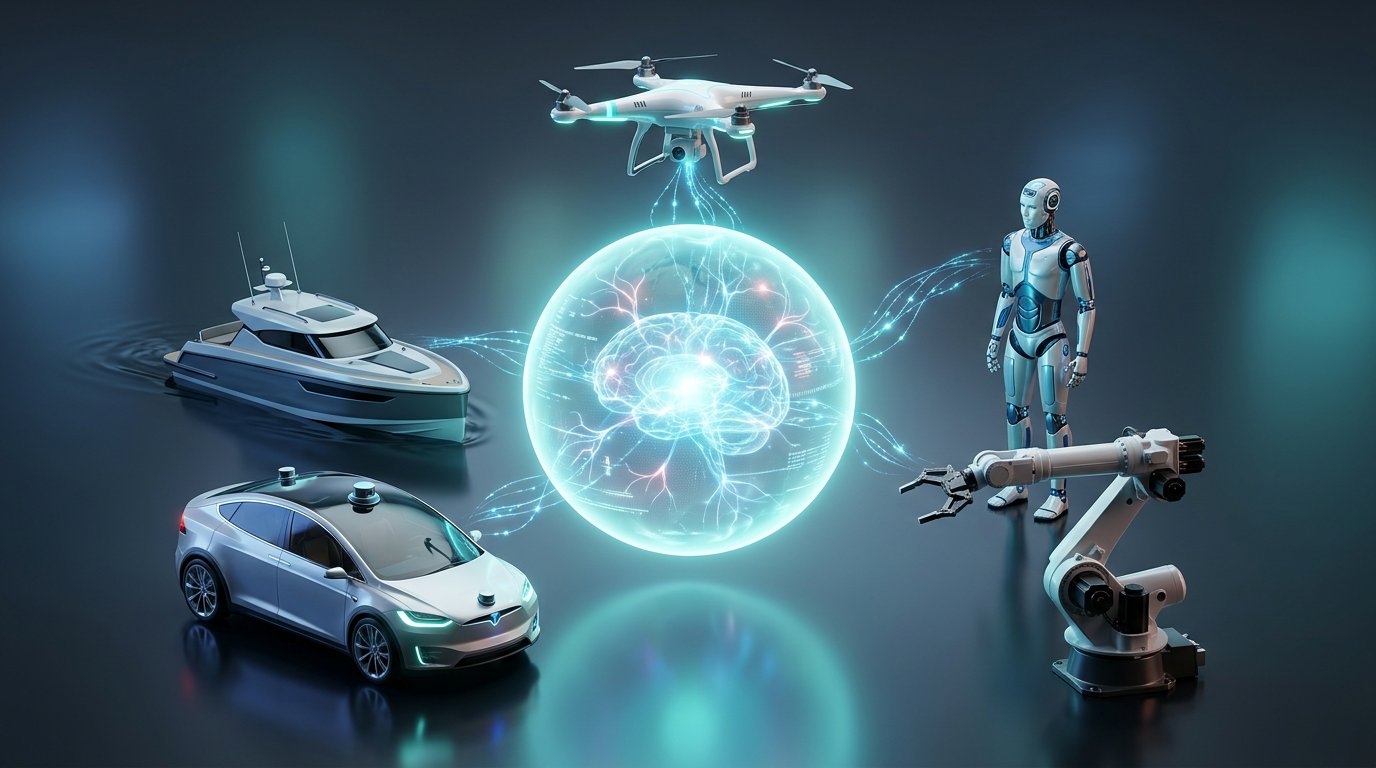
Most machines that think for themselves are trained as loners. A self-driving car learns from road footage, a robot arm learns from grasping trials, and a drone learns from flight logs, each with its own data and its own model. XPENG argues that this is wasteful, because a car judging the gap to the vehicle ahead and an arm judging the distance to a cup are solving versions of the same problem. On November 24, 2026, the company unveiled WorldGPT, a single model built to learn across both.
The details here come from XPENG’s announcement. The benchmark results are the company’s own claims, so treat them as reported rather than independently verified.
Six kinds of machine, one model
WorldGPT is part of XPENG’s Turing World Model family. According to the company, it brings together learning from six types of machines: cars, boats, drones, single-arm robots, dual-arm robots and humanoid robots. XPENG calls it the first world model to show both prediction and action planning across all six.
The idea is that perception, reasoning, prediction and planning do not have to be rebuilt for each body. By learning from visual data across different machines, the model picks up shared principles about how the physical world behaves. Given earlier camera footage and a short instruction, XPENG says WorldGPT can generate video of how a scene might unfold, plan the actions needed to finish a task and explain its reasoning in plain language.
A cloud teacher and small student models
The practical twist is how the knowledge reaches real hardware. XPENG describes WorldGPT as a large, cloud-based “teacher model” that learns shared knowledge from every machine type. That knowledge is then distilled into smaller, specialised models designed to run directly on each individual machine.
Today, adding AI to a new kind of machine usually means collecting specialised data, training a dedicated model and adapting it to the hardware and its movements. With a shared foundation, the company says developers can instead start from common knowledge and spend their effort adapting it to a specific task and body. XPENG’s stated expectation is lower development cost, better data efficiency and an easier path to extending physical AI to new kinds of machines.
What the benchmarks show
XPENG reports that WorldGPT took 12 first-place rankings on public benchmarks across four areas as of November 12, 2026: autonomous driving, robotic manipulation, visual understanding and video generation.
In driving, it ranked first on four evaluations, including NAVSIM v2, where it led in both standard and challenging scenarios. In robotics, it averaged a 95.2% success rate across 50 single-arm manipulation tasks, which the company says is the highest among published models evaluated, and it also ranked first in tests of adapting to unfamiliar tasks and changing environments. For visual understanding, it topped CV-Bench and two BLINK subtasks that probe spatial understanding and object relationships. In video generation, it posted the best overall score on VBench 2.0 and tied for first on WorldOlympiad, which tests long-horizon simulation.
XPENG says full results are available on the project website. Rankings on public leaderboards can shift quickly, and the announcement gives no independent replication, so the best reading is that the results are promising and worth watching.
What it means
For carmakers and robotics teams, the headline is economics. If one teacher model can feed small models for very different machines, a company with data from cars could in principle help its robots, and the reverse. That would make the large cost of training physical AI easier to spread across product lines, which matches XPENG’s own mix of smart vehicles, robotaxis and humanoid robots.
The model’s ability to simulate how the world responds to different actions also hints at a second benefit. XPENG says this could open new possibilities for AI training and continuous improvement, since a system that can imagine outcomes can practise without every trial happening in the real world.
There are open questions. The announcement does not say when, or whether, WorldGPT-derived models will appear in shipping vehicles or robots, and it does not detail the compute needed for the teacher model. Cross-machine transfer is an appealing claim, but its real test will be how much a robot arm actually gains from driving data.
Conclusion
WorldGPT reframes physical AI as a shared foundation with specialised students, rather than a separate model for every machine. If the benchmark lead holds up and the distilled models work on real hardware, the approach could make intelligent machines cheaper to build and faster to extend.