
RoboBee : The tiny flying submarine

A Harvard University lab has developed the first insect-size robots capable of flight and swimming. Researchers at the Harvard Paulson School have demonstrated a flying, swimming, insectlike robot, easing the way to create future aerial-aquatic robotic vehicles. Coming from the Harvard Microrobotics Lab, this discovery can only mean one thing, swimming RoboBees. The biggest challenge involved the conflicting design requirements. Aerial vehicles require large airfoils such as wings or sails to...
More
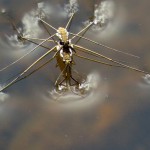
Researchers discover the key to staying dry underwater

Imagine staying dry underwater for months. The latest research from Northwestern University engineers identified a wide variety of surfaces that can do just that. Through a combination of analysis of “air-retaining insect surfaces” used by aquatic insects, aging and degassing experiments on material surfaces, and molecular simulations, these engineers believe they understand what keeps certain surfaces dry underwater. Saturation of air within “valleys” on surfaces (less than 1µm wide) defl...
More

New Technology Creates “Cyborg Insects”

Scientists at the University of California demonstrated a new technology for creating "cyborg insects." That is, beetles implanted with miniaturized electronics that allows the insects to be controlled. The flying beetle is powered by a wireless signal from a mobile transmitter that controls the insect. Varying impulses trigger an appropriate response from the beetle so that it flies according to its handler. The movements of flying insects is controlled using a radio transmitter and a min...
More