Pluto Ice Volcanoes

Pluto may have two ice volcanoes that spew water ice, nitrogen, ammonia, and methane onto the dwarf planet's surface, NASA announced today. The potential volcanoes were spied near Pluto's South Pole, in images taken by NASA's New Horizons spacecraft during its July flyby. NASA scientists used the photos to measure the mountains, they are several miles high and tens of miles wide, with large holes in their summits. "On Earth that generally means one thing a volcano," said Oliver White, New Horizo...
More


Our Bodies, our Microbial Clouds.

We leave a trail of microbes on every surface we touch, from pens and keyboards to door handles and elevator buttons. Everywhere you go, in everything you do, you are surrounded by an aura of microbes. They drift down from your hair when you scratch your head, they fly off your hand when you wave to your friend, and they spew out of your mouth when you talk. Even when you sit around doing nothing, you’re sitting in your own, personal microbial bubble. In addition to leaving our mark on surfaces,...
More

New “tricorder” technology might be able to “hear” tumors growing.

A team of scientists from Stanford University is testing a new “tricorder” technology able to remotely detect abnormal matter, such as buried plastic explosives or even early stage cancers in humans, by manipulating microwaves and ultrasound. The new “radio frequency (RF)/ultrasound hybrid imaging system,” the brainchild of Assistant Professor Amin Arbabian and Research Professor Pierre Khuri-Yakub, was designed for remote detection of embedded objects in a number of different kinds of matter, i...
More

The surprising trick jellyfish and lampreys use to swim.

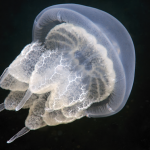
Jellyfish and lampreys have among the most energy-efficient swimming motions of any animal. From a long time, researchers have assumed that in order to move forward, fly or swim, humans and animals exert pressure on surface, air or water around them. But a new study published in the journal Nature Communications has revealed that two sea animals do not follow the general theory. Jellyfish and lampreys pull their way through the water, as per the study. A Stanford led team shows how these anci...
More

NASA’S New Horizons finds blue skies and red water ice on Pluto.

Images sent back by NASA’s New Horizons spacecraft last week reveal that Pluto has blue atmospheric hazes and water ice on its surface. Pluto’s haze layer shows its blue color in this picture taken by the New Horizons Ralph/Multispectral Visible Imaging Camera (MVIC). The high-altitude haze is thought to be similar in nature to that seen at Saturn’s moon Titan. The source of both hazes likely involves sunlight-initiated chemical reactions of nitrogen and methane, leading to relatively small, ...
More

Researchers discover the key to staying dry underwater

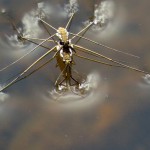
Imagine staying dry underwater for months. The latest research from Northwestern University engineers identified a wide variety of surfaces that can do just that. Through a combination of analysis of “air-retaining insect surfaces” used by aquatic insects, aging and degassing experiments on material surfaces, and molecular simulations, these engineers believe they understand what keeps certain surfaces dry underwater. Saturation of air within “valleys” on surfaces (less than 1µm wide) defl...
More

Unique 3D Pen that Draws In The Air

3Doodler is the world’s first 3D printing pen. The pen, created by science inventors Max Bogue and Peter Dilworth is called the 3Doodler, and allows the user to draw in the air. It does not require any software but simply needs to be plugged into an electrical outlet for use. This pen has been fed into with colorful plastic thread. The thread is then extruded as heated plastic that cools and solidifies instantly as it exits the tip. This allows solid 3D structures to be drawn on any surfac...
More