Rice Splits CO2 With Visible Light at Room Temperature

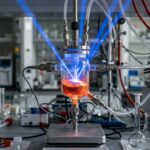
Laboratory glass reactor with blue light beams striking glowing copper-colored powder inside
AI-generated illustration Carbon dioxide is one of the most stubborn molecules in chemistry, which is exactly why it is so hard to turn into something useful. Rice University researchers now report a way to split it using visible light at room temperature, a step toward recycling emissions into raw material for industry. The work was published in the Proceedings of the National Academy of Sciences and announced by Rice News on November 20, 2026. The problem with splitting CO2 Conventi...
More

Mars to lose its largest moon, but gain a ring.

Mars’ largest moon, Phobos, is slowly falling toward the planet, but rather than smash into the surface, it likely will be shredded and the pieces strewn about the planet in a ring like the rings encircling Saturn, Jupiter, Uranus and Neptune. Mars could gain a ring in 10-20 million years when its moon Phobos is torn to shreds by Mars gravity. Though inevitable, the demise of Phobos is not imminent. It will probably happen in 20 to 40 million years, leaving a ring that will persist for anywhere ...
More

Journey to Mars: Detour to the Moon is the best way to travel to the Red Planet.

As NASA gears up for a mission to Mars, planning a route to the Red Planet is important. Now, researchers have found that to save on weight and have concluded that a detour to the moon is the best route to Mars. Previous studies have suggested that lunar soil and water ice in certain craters of the moon could potentially be mined and converted to fuel. With the assumption that this tech exists at the time of a Mars mission, taking a detour to the moon to refuel actually reduces the mass of a mis...
More

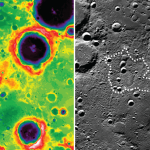
Mound near lunar South Pole formed by unique volcanic process.

Mafic Mound, a distinctive and enigmatic feature near the Moon’s South Pole, is a volcanic structure unlike any other found on the surface of the Earth’s only natural satellite, says a team of planetary geologists at Brown University. It stands about 2,600 feet tall and 47 miles across and lies in the middle of a giant impact crater known as the South Pole-Aitken Basin. “If the scenarios that we lay out for its formation are correct, it could represent a totally new volcanic process that’s ne...
More

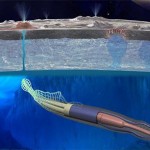
Soft robot to swim through Europa’s oceans

A soft, swimming robot for exploring Jupiter’s moon Europa. A Cornell engineering team has received a nine-month, $100,000 starter grant from NASA to develop a soft, swimming robot suitable for exploring the harsh conditions of other worlds, notably Jupiter’s moon Europa. An amphibious robot that can swim through the oceans of distant moons and planets could be the next iteration of self-sustaining, robotic space exploration. The Cornell team developing this otherworldly robot is led by Ma...
More