
Climate projections drive decisions about power grids, public health and farming, yet the physics-based models behind them can take months on a supercomputer to simulate a single future. A new technique from MIT aims to shrink that bottleneck by changing what AI models learn from.
In research announced by MIT News on November 12, 2026 and published in the Proceedings of the National Academy of Sciences, a team describes a way to train climate emulators with a fraction of the usual data whil...
More
Environment
KAIST Liquid-Crystal Separator Keeps 94% Capacity at 4C Charging

AI-generated illustration
Fast charging and long battery life usually pull in opposite directions. Push lithium metal batteries to charge quickly and the lithium can grow into sharp, branch-like deposits that wear out the cell. A KAIST team now reports a separator design that gives lithium ions a straighter route, and it kept 94% of its capacity after 100 fast-charge cycles in the lab.
KAIST announced the work on November 9, 2026. It comes from a joint team led by Professors Dong Ki Yoon...
More
UADA Pit-less Pump Cuts Rice Irrigation Water 27 Percent
Rice is famous for needing water, and farmers who grow it in flooded, levee-ringed fields pay for that habit in pumping costs, tillage and time. A decade of work at the University of Arkansas System Division of Agriculture (UADA) has produced a different answer: a pump that lets rice grow in furrows with far less water. In a November 10, 2026 announcement, UADA said the Pit-less Tailwater Pump is now commercially available.
This article is a news summary of the university's release and is n...
More
Lunar Energy Merges Home Battery, Solar and a Bidirectional EV Charger
Home batteries, rooftop solar and electric-vehicle chargers usually arrive as three separate purchases, each with its own app and its own idea of when to run. Lunar Energy, a Mountain View, California company founded in 2020, wants to merge them. On November 11, 2026 it launched a next-generation Lunar System and an all-new Lunar Fast Charger.
A modular battery system
According to the company's press release, the new Lunar System scales in 5 kWh blocks from 10 kWh to 30 kWh in a single towe...
More
QuantumScape Osprey: 1,000 Solid-State Cycles at One Atmosphere
Solid-state batteries have been the electric-vehicle industry's most repeated promise for years: more energy, faster charging, better safety. The sticking point has been making them work outside a lab. On 11 November 2026, QuantumScape announced Osprey, an open platform for all-solid-state batteries that it says clears two of the biggest practical hurdles at once.
The company reports that Osprey cells have delivered what it calls the first public data showing a sulfide-based cathode cycling...
More
UCL Chemistry Lifts Water-Based Batteries With 4-Electron Iodine
Battery farms are a quiet backbone of the clean-energy shift. They soak up surplus solar and wind power and hand it back when the sky is dark and the air is still. Most of them rely on lithium-ion cells, the same family that powers laptops and e-bikes. A research team led by University College London has now reported a chemistry that could widen the options: a water-based battery whose iodine stores roughly twice as much charge as before.
The work was published in Nature and announced by UC...
More
TerraNova: Microsoft and Terradot’s AI for Cheaper Carbon Removal
Crushed rock, climate and a weather model
Spreading powdered rock on farmland sounds low-tech, yet it is one of the more promising ways to pull carbon dioxide out of the air. On November 12, 2026, Microsoft's Source feature described TerraNova, a new AI model from carbon-removal company Terradot and Microsoft that aims to make the technique cheaper to verify and easier to scale.
How enhanced rock weathering works
Rainwater slowly breaks down certain rocks through chemical reactions that ...
More
Outer Spaces OS1 Turns a Backyard Pavilion Into a Home Power Plant
Most home batteries hang on a garage wall or sit on a slab beside the house. A new California company wants to hide the battery under your backyard deck and put the solar panels on the roof of a pavilion instead of your house.
Outer Spaces, based in El Segundo, announced on November 9, 2026 that it will show its OS1 system in person for the first time at RE+ 2026, held November 16 to 19 at the Las Vegas Convention Center. The company calls OS1 the world's first solar pavilion and battery de...
More
Waterloo’s Boiling Drops Could Cool AI Chip Hotspots Fast
Every AI query warms a chip somewhere, and the chips that run them are getting hotter. A University of Waterloo team now says a single drop of boiling coolant, placed exactly where a processor spikes, could keep data centre hardware cooler without paying for expensive fluid across the whole tank.
On November 10, 2026, the university released results of a hybrid immersion cooling concept from its engineering faculty, published in the Journal of Colloid and Interface Science. In lab tests, on...
More
Huawei LUTERRA S2 Packs Home Solar and Storage Into One Quiet Unit
Home batteries are usually a stack of separate boxes: an inverter, one or more battery packs, a controller and a lot of wiring. On November 9, 2026, in Palma, Spain, Huawei announced the LUTERRA S2, an all-in-one residential energy system that folds a hybrid inverter, storage and AI energy management into one stackable unit. The company says it can be installed and commissioned in minutes.
This article is based on Huawei's launch announcement. The performance figures below are the company's...
More
Rutgers Study: Iron-Nickel Catalyst Keeps Zinc-Air Cells Running
Zinc-air batteries are the quiet workhorses inside hearing aids: cheap, compact and, for the most part, thrown away after one use. A research team that includes a Rutgers professor now reports a way to make a rechargeable version run steadily for 1,000 hours, without leaning on platinum-style precious metals. The Rutgers Climate and Energy Institute summarized the work on November 4, 2026.
The study appeared in the journal Advanced Energy Materials. Tewodros Asefa, an RCEI affiliate and pro...
More
HKU Builds a Megawatt Power Module From Gallium Oxide
Every phone charger, electric car and power grid relies on semiconductor switches that control electricity. For decades those switches have been made of silicon, and silicon is nearing its physical limits. Engineers at The University of Hong Kong (HKU) now report a module built on a newer material, gallium oxide, that switched 1,000 volts and 1,000 amperes, a peak of one megawatt. According to HKU's announcement, it is the first time a module made from this class of material has reached tha...
More
Octopus, CATL and Ampace Plan Smarter, Cheaper Home Batteries
Home batteries are quietly changing from boxes on a garage wall into connected devices that decide when to buy, store and sell electricity. On November 3, 2026, one of Europe's best-known energy retailers announced a partnership meant to speed that shift along.
Octopus Energy and Xiamen Ampace Technology Limited signed a Memorandum of Understanding (MoU) to explore next-generation smart home energy storage that pairs high-performance hardware directly with intelligent software, according to...
More
WOTA Unit Recycles Home Water for Water-Scarce Caribbean Islands
Imagine a household that takes 100 showers' worth of water out of its own wastewater in a single month. That is roughly what a Japanese company says happened in a demonstration home in Antigua and Barbuda, and it is now using the result to argue for a different way to supply water on islands.
On November 3, 2026, WOTA, a Tokyo-based water technology company and Earthshot Prize finalist, issued a news release timed to the Commonwealth Business Forum 2026, held November 2 to 4. In it, WOTA pr...
More
Intelligent, Energy-Saving Mug
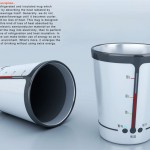
The green mug is a refrigerated and insulated mug which is powered by absorbing the heat radiated by the water/ beverage.
New Green Smart Glass is intended to make getting the perfect cup of coffee both easier and more eco-friendly.
Chengzhu has created the Green Smart Glass which is a refrigerated and insulated mug which is powered by absorbing the heat radiated by the water/ beverage itself.
Generally we do not drink hot coffee until it becomes cooler so there will be loss of heat.
...
More
Stick-on Micro-Electric Medical Tattoo Invented

A novel stick on tattoo has been developed that can effectively measure data about the human heart, brain waves and muscle activity.
The latest in medical invention is new type of ultra-thin, self-adhesive electronic device that can effectively measure the aforementioned vital signs without the use of bulky equipment, conductive fluids, or glues.
This product is in the form of a tattoo which has to be applied to the skin like any ink transfer tattoo. It is made from a rubbery polymer subst...
More
World’s First Undersea Resort Built

The holiday complex, Poseidon Resort, has been developed. This is no ordinary hotel--it's located 40 feet under the sea in a lagoon off the shore of a private island in Fiji.
L. Bruce Jones, a submarine inventor, has invented the world's first undersea resort. It was due to open in 2008 and has an estimated 150,000 potential guests on its waiting list. It has taken 13 years in the making.
The Poseidon Resort comprises of approximately 225 acres and is about a mile long.
Accessible via a...
More
The Floating Mug – a coaster and cup in one

Say no to separate coasters with the latest invention of the porcelain Floating Mug. A new mug with a built-in coaster was invented.
Hot beverages produces heat and slight moisture that can be damaging to your furniture. Sipping from the same area on the lip of a cup causes moisture to drip down that side thus causing stains.
The Floating Mug is a novel white porcelain mug which is perfect for coffee or tea. This mug has a handle designed and balanced to function also as a coaster so when ...
More