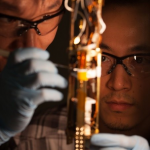
Lisa Pathfinder launches to test space ‘ripples’ technology

Europe has launched the Lisa Pathfinder satellite, an exquisite space physics experiment. It will test the technologies needed to detect gravitational waves, the warping of space-time produced by cataclysmic events in the cosmos. Having such a capability would make it possible to detect the merger of monster black holes, a marker for the growth of galaxies through time. Lisa Pathfinder went into orbit on a Vega rocket from French Guiana. The satellite is being sent in the direction of the Sun, t...
More

NASA Scientist Kickstarts Cold Shoulder Weight-Loss Vest.

Invented by Dr. Wayne B. Hayes, a professor at the University of California and a visiting scientist at NASA's Jet Propulsion Laboratory in Pasadena, Calif., the "Cold Shoulder" calorie-burning vest apparently is based on hard science, rather than science fiction. According to info on Kickstarter, scientists have spent decades studying how mild cold exposure can enhance calorie burn, and the results seem to show that it works. Hayes works with NASA scientists who purportedly study ice, so he ...
More

Aerion Mouse

Aerion Mouse is a gesture-driven computer mouse that’s somewhat smaller than traditional mice. It gets placed between the top of any two of the user’s fingers. The user then points the mouse at the display to operate it and, instead of clicking on any buttons, just leans to the left to achieve what a typical left click on a mouse would and leans to the right for a right click. One main benefits to Aerion is that it allows one to keep fingers close to a typing position without having to grab a se...
More

Pot Breathalyzer

An Oakland company working with scientists from the University of California at Berkeley is claiming a breakthrough in the race to develop an instant roadside marijuana Breathalyzer. Hound Labs Inc, said on Wednesday it had found an accurate way to measure THC, the psychoactive component in cannabis within one or two blows. The portable device is designed to help determine if a driver is impaired from recent marijuana use. The idea is to replace a complicated assortment of costly blood and urine...
More

Walli – Smart Wallet

Walli is an intelligent wallet that keeps track of your valuables. It's an interactive system between your phone and your wallet, so if you lose your wallet then your phone notifies you, if you lose your phone, just tap the wallet twice and your phone will automatically ring. Walli connects to your smartphone over Bluetooth. Once connected, the Walli app will display notification on your phone once you get too far from it. Connecting to an iOS and Android app over Bluetooth 4.0, it sends a displ...
More

Hypersonic rocket engine could revolutionize space flight.

Oxfordshire-based Reaction Engines are developing a new aerospace engine class that combines both jet and rocket technologies. They call it the greatest advance in propulsion since the jet engine which will help potentially revolutionizing hypersonic flight and dramatically reducing the cost of space access. SABRE, which stands for Synergetic Air-Breathing Rocket Engine, is designed to enable aircraft to operate from a standstill on the runway to hypersonic flight in the atmosphere, and then tra...
More

AquaFresco – Reinventing laundry

AquaFresco provides the state-of-the-art filtration technology which regenerates 95% of laundry wastewater. Three MIT grad students have invented a washing-machine filter that cleans wastewater and reuses it over and over again. “Washing machines are one of the major sources of detergent pollution in rivers,” Huang says. “Current laundry technology is not sustainable. A regular washer discards the water right into the drain after one usage, but less than 1 percent is the actual waste component.”...
More

Amazon Alexa next generation of virtual asssitant that can also control devices

Amazon Echo is a wireless speaker and voice command device from Amazon.com. The device consists of a 9.25-inch (23.5 cm) tall cylinder speaker with a seven-piece microphone array.[1] The device responds to the name "Alexa"; this "wake word" can be changed by the user (to one other choice at present: "Amazon").[2] The device is capable of voice interaction, music playback, making to-do lists, set alarms, stream podcasts, play audiobooks, provide weather, traffic and other real time information. I...
More

“Li-Fi” 100 Times Faster Than “Wi-Fi”

Li-fi is a new means of delivering data using visible spectrum as against the radio waves used by most other methods. This new technology has already been tested in a functional office. What makes Li-fi stand apart is the astonishing speed at which can deliver access to the internet, often 100 times faster compared to Wi-fi at a mind-boggling speed of 1Gbps. You need a light source similar to an LED bulb, a photo detector and an internet connection to use Li-fi. The visible spectrum of light use...
More

Using jeans to purify the air.

There are more jeans in the world than people. That sparked an idea in the mind of University of Sheffield chemist Tony Ryan. Why not use people’s penchant for wearing denim to help purify the air? With thoughts of reducing pollutants such as the nitrogen oxides and volatile organic compounds emitted by vehicles, power plants, residential heating, cooking and various consumer products, Ryan, in partnership with former fashion designer Helen Storey, came up with the concept of “Catalytic Clothing...
More

Xerox printed memory labels aim to curb counterfeiting.

Xerox on Wednesday announced a pair of printed packaging labels with embedded memory designed to help curb counterfeiting. Also known as printed memory, the labels are equipped with up to 36 bits of rewritable memory. That may not sound like much in a world that deals largely in gigabytes and terabytes but according to Xerox, it’s enough to store up to 68 billion points of data. The product line-up is made up of the aforementioned Xerox Printed Memory and the second offering is the same except t...
More

Miniaturizable magnetic resonance

A garnet crystal only one micrometre in diameter was instrumental in a University of Alberta team of physicists creating a route to “lab-on-a-chip” technology for magnetic resonance, a tool to simplify advanced magnetic analysis for device development and interdisciplinary science. “To most, a gem so tiny would be worthless, but to us, it’s priceless,” says Mark Freeman, University of Alberta physics professor and Canada Research Chair in condensed matter physics. “It was the perfect testbed for...
More

Porous Liquid.

Researchers in the School of Chemistry and Chemical Engineering at Queen’s, along with colleagues at the University of Liverpool, UK, and other, international partners, have invented the new liquid and found that it can dissolve unusually large amounts of gas, which are absorbed into the ‘holes’ in the liquid. Porous materials, as their name would suggest, are materials with holes. These are materials that look totally solid to the naked eye, but on a molecular level, contain lots of empty space...
More

Cyborg Rose: Researchers implant electronic circuits inside plants.

A team of Swedish researchers, by using living roses, has created analogue and digital electronic circuits inside living plants, calling them "electronic plants". The experiment demonstrates wires, digital logic and displays elements fabricated inside the plants that could develop new applications for organic electronics and new tools in plant science. The group at Linkoping University in Sweden, under the leadership of professor Magnus Berggren, used the vascular system of living roses to build...
More

Speedy Microscopic Submarines powered by Light

A team from Rice University has developed single-molecule nanosubmarines that could eventually be used to deliver medicines directly inside the body. Back in 2006, this same group developed nanocars, a single-molecule vehicle with four wheels, axles, and independent suspensions that could be “driven” across a terrestrial surface. Unfortunately, many of the nano-scale devices developed since then either required or emitted toxic chemicals. Several years ago, however, a new motor developed by a gr...
More

Drug prevents Type 1 diabetes in mice

A compound that blocks the synthesis of hyaluronan, a substance generally found in in all body tissue, protects mice from getting Type 1 diabetes.Nadine Nagy and Paul Bollyky and their colleagues found that a drug helped prevent the onset of Type 1 diabetes in mice. They hope to find out if the drug will work similarly in humans. Type 1 diabetes, formerly called juvenile diabetes, afflicts one in 300 people in the United States. A compound that blocks the synthesis of hyaluronan, a substance ...
More

Moox Bike, the first-of-its kind bike and scooter hybrid.

With Moox Bike, you can pedal like a traditional bicycle or use the patented platform design to glide and scoot. The Moox Bike begs to be noticed. Its innovative design and striking colors not only make it fun to ride and glide, but turns heads along the way. Its design, construction and architecture provide an extremely comfortable and fluid ride. The Moox Bike is structurally sound with no-fuss. It will last for years with minimal maintenance. Each Moox Bike is individually tested and adheres ...
More

Hydrogel superglue is 90 percent water.

Nature has developed innovative ways to solve a sticky challenge. Mussels and barnacles stubbornly glue themselves to cliff faces, ship hulls, and even the skin of whales. Likewise, tendons and cartilage stick to bone with incredible robustness, giving animals flexibility and agility. The natural adhesive in all these cases is hydrogel, a sticky mix of water and gummy material that creates a tough and durable bond. Engineers at MIT have developed a method to make synthetic, sticky hydrogel th...
More

Block the bad sounds and harness the good with Hush earplugs

A new pair of “smart earplugs” called Hush, combine sound-eliminating foam and noise-masking technology. Many wearables monitor your sleep, but they don’t provide solutions to allow for better sleep. The Hush device fits comfortably in a user’s ear, and it is surrounded in a soft silicon surface. The product helps users sleep through snoring, loud neighbors, and other noises but it doesn’t block the noises that are necessary, like alarm clocks or emergency phone calls. “Hush’s ultimate goal i...
More

Bistro cat feeder identifies cats using facial recognition.

Bistro, an automatic feeder that uses facial recognition technology to ensure the food is going to its intended recipient has been just introduced by a group of cat lovers. We all know that cats requires regular feeding, watering and the occasional trip to the vet, but few of us would know exactly how our cat’s health, weight, and hydration are faring on a day-to-day basis. And, when we do feed them, how do we even know that the food we put out for our feline friend is actually being eaten by th...
More

Lasers could rapidly make materials hotter than the Sun.

Lasers could heat materials to temperatures hotter than the centre of the Sun in only 20 quadrillionths of a second, according to new research that could revolutionise energy production. Physicists from Imperial College London have devised an extremely rapid heating mechanism that they believe could heat certain materials to ten million degrees in much less than a million millionth of a second. The method, proposed for the first time, could be relevant to new avenues of research in thermonuclear...
More

Most Extensive Face Transplant.

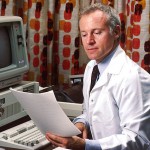
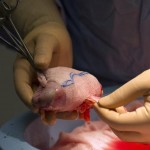
This past August, Hardison, now 41, received an entirely new scalp and face. For the first time since 2001, he has ears, a nose, lips, and eyelids, the last was especially crucial because, although he retained his vision on the fire, he was unable to blink or close his eyes for 14 years. His new face was donated by 26-year-old David Rodebaugh, a young BMX biker from Brooklyn, who was pronounced brain dead after being thrown off his bike. The revolutionary face transplant took 26 hours and was pe...
More

Flying pixels create self-levitating displays

A team of researchers at Queen's University's Human Media Lab have unveiled a system of flying 'BitDrones' that let users explore virtual information by interacting with levitating voxels. The system, called BitDrones, allows users to explore virtual 3D information by interacting with physical self-levitating building blocks. BitDrones is the first step towards creating interactive self-levitating programmable matter, materials capable of changing their 3D shape in a programmable fashion using s...
More

New flu tracker uses Google search data better than Google.

A team of Harvard statisticians has come up with a new way to track the flu virus using Internet search data. The system uses a method that has been used before, tracking searchers for key words and phrases, but has coupled it with additional data to improve its accuracy. The new model, ARGO (AutoRegression with Google search data), was published in the Proceedings of the National Academy of Sciences and was built on Google Flu Trends, which was Google’s flu tracking model that emerged in 200...
More

Nanotechnology advances could pave way for implantable artificial kidney

A surgically implantable, artificial kidney could be a promising alternative to kidney transplantation or dialysis for people with end stage renal disease (ESRD). Currently, more than 20 million Americans have kidney diseases, and more than 600,000 patients are receiving treatment for ESRD. U.S. government statistics indicate kidney care costs the U.S. health care system $40 billion annually, accounting for more than 6 percent of Medicare spending. “We aim to conduct clinical trials on an implan...
More

Samsung Flexible Smartphone

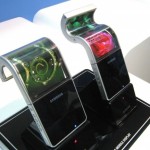
Samsung promises that flexible and foldable screens are coming to devices soon. The company’s latest patent, which was spotted by Patently Mobile, is for a flexible phone that morphs into a smart bangle you can strap onto your wrist. It’s an entirely bizarre and futuristic idea that certainly puts more focus on accessibility than style, but it sure sounds awesome. The patent features a flexible OLED screen that’s so flexible you can curl it into a bracelet and wear it on your wrist as a smart...
More

Milky Way

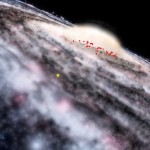
A team of astronomers, led by Istvan Dékány of the Pontificia Universidad Católica de Chile, has used data from the survey, taken between 2010 and 2014, to make a remarkable discovery, a previously unknown component of our home galaxy, the Milky Way. “The central bulge of the Milky Way is thought to consist of vast numbers of old stars. But the VISTA data has revealed something new, and very young by astronomical standards!” says Istvan Dékány, lead author of the new study. Analysing data fro...
More

Memory and conductivity

Scientists from Stanford University and the Department of Energy’s SLAC National Accelerator Laboratory have made the first direct images showing that electrical currents can flow along the boundaries between tiny magnetic regions of a material that normally doesn’t conduct electricity. The results could have major implications for magnetic memory storage. "This can provide a more straightforward way to use magnetic material as memory,” said Eric Yue Ma, a graduate student in the laboratory of Z...
More

Big Data

Massachusetts Institute of Technology (MIT) researchers at the Computer Science and Artificial Intelligence Laboratory (CSAIL) are looking to take human intuition out of big data analysis by letting computers choose the feature set used to identify predictive patterns in the data. This effort is called “Data Science Machine”. Big Data represents a huge, complex ecosystem that brings together innovative processes from across the spectrum of data analysis, storage, networking, curation, search,...
More

New graphene based inks for high-speed manufacturing of printed electronics.

Developed by researchers at the University of Cambridge in collaboration with Cambridge-based Technology Company Novalia, the method allows graphene and other electrically conducting materials to be added to conventional water-based inks and printed using typical commercial equipment. This is the first time that graphene has been used for printing on a large-scale commercial printing press at high speed. A low-cost, high-speed method for printing graphene inks using a conventional roll-to-roll p...
More