MIT’s Flapping Microrobot Now Flies With Its Own Sensors

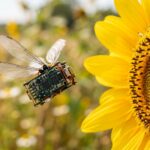
Tiny winged robot with a miniature circuit board hovering next to a sunflower
AI-generated illustration For a decade, MIT's tiny flying robots have been remarkably athletic, with bumblebee-like speed, agility and durability. They had one big limitation: they were tethered to a laboratory motion-capture system because they could not carry the electronics needed to know where they were. According to MIT News, that has changed. A new version carries its own sensors and computer and still flies precisely. Why weight was the obstacle The robot is roughly the size an...
More
Boise State’s 2D Alloy Ink Prints Tiny, Powerful Supercapacitors

Boise State's 2D Alloy Ink Prints Tiny, Powerful Supercapacitors (illustration)
AI-generated illustration Batteries get most of the attention in energy storage, yet they are not good at everything. They struggle with sudden, large bursts of current, they wear out after roughly 1,000 to 10,000 cycles, and they do not like the cold. At Boise State University, researchers have just reported a printable material that could help close those gaps from the other side, by making better supercapacitors that can be printed onto flexible surfaces. According to Boise State News...
More

Caltech’s Nanosyringes Inject Working Proteins Into Plant Cells

Translucent glowing syringes releasing luminous particles into the surface of a green leaf
AI-generated illustration Getting a useful protein into a plant cell is surprisingly hard. Every cell is wrapped in a rigid wall and a membrane, and most delivery tricks either rely on inserting DNA or struggle to get past those barriers. On November 18, 2026, Caltech announced a different route: bacterial "nanosyringes" that have been re-aimed at plant cells and loaded with working molecular tools. The work, led by Gozde Demirer's lab in chemical engineering, appears in Nature Nanotechn...
More

Penn’s Self-Sensing Artificial Muscles Give Soft Robots Fine Control

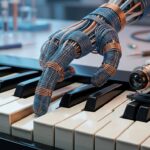
Robotic hand wrapped in blue and copper coiled fibers pressing piano keys next to a small mechanical eye module on a lab bench
AI-generated illustration A robotic finger presses a piano key, pauses, and moves on to the next note. Nearby, an artificial eye shifts its gaze through a series of small, controlled steps. According to Penn Engineering, both demonstrations rely on a new kind of artificial muscle that can sense its own state, hold intermediate positions, and coordinate with other muscles. The work, announced on November 12, 2026, comes from teams led by Shu Yang and Cynthia Sung. It is a small-scale stor...
More

KAIST Battery Electrode Turns Curved Drone Legs Into Storage

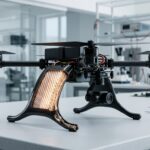
A quadcopter drone on a lab bench with one curved carbon-fiber leg cut away to show a glowing woven battery layer
AI-generated illustration Most drones and robots carry their energy the way a hiker carries a water bottle: as a separate load strapped onto a frame that does its own job. A new electrode from KAIST points to a different idea, where a landing leg or a robot limb is also part of the battery. The catch has always been shape, because real frames are curved and hollow. On November 18, 2026, KAIST announced an electrode built to work in exactly those places. What KAIST built According to K...
More

PAN 2: An Open World Model That Simulates What Happens Next

PAN 2: An Open World Model That Simulates What Happens Next editorial illustration
AI-generated illustration A language model predicts the next word. A world model tries to predict the next moment of the world itself. On November 10, 2026, the Institute of Foundation Models (IFM), established by Mohamed bin Zayed University of Artificial Intelligence (MBZUAI), released PAN 2, an open, general-purpose world model aimed at physical intelligence. The pitch is simple to state: give PAN 2 a starting scene and an action described in words, and it simulates a video of what ha...
More

AKU’s Machine Learning Maps Hidden Diabetes Risk Groups

AI-generated illustration Every hospital discharge leaves behind a trail of diagnosis codes. Most of the time those codes are used for billing and then forgotten. A team at Aga Khan University (AKU) in Karachi asked a different question: if you hand fourteen years of those codes to an unsupervised machine learning algorithm, will it find patterns that doctors and hospital planners should care about? The answer, published in BMJ Open, is yes. Working with records from 78,271 adults with d...
More

MIT Trains Faster Climate Emulators With Synthetic Scenarios

Climate projections drive decisions about power grids, public health and farming, yet the physics-based models behind them can take months on a supercomputer to simulate a single future. A new technique from MIT aims to shrink that bottleneck by changing what AI models learn from. In research announced by MIT News on November 12, 2026 and published in the Proceedings of the National Academy of Sciences, a team describes a way to train climate emulators with a fraction of the usual data whil...
More

KAIST Liquid-Crystal Separator Keeps 94% Capacity at 4C Charging

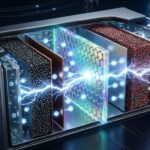
Cutaway view of a battery cell with a thin liquid crystal separator layer
AI-generated illustration Fast charging and long battery life usually pull in opposite directions. Push lithium metal batteries to charge quickly and the lithium can grow into sharp, branch-like deposits that wear out the cell. A KAIST team now reports a separator design that gives lithium ions a straighter route, and it kept 94% of its capacity after 100 fast-charge cycles in the lab. KAIST announced the work on November 9, 2026. It comes from a joint team led by Professors Dong Ki Yoon...
More

AI-Designed Quantum Circuits Cut Resources Up to 39x, QuEra Says

Quantum computers will only become useful when two curves meet: the hardware gets bigger and more reliable, and the algorithms that run on it get cheaper. A new collaboration between QuEra Computing, Harvard University and Anthropic targets the second curve, and the numbers are eye-catching. According to QuEra's November 10, 2026 announcement, AI-designed circuits cut a combined gate-and-qubit resource metric by as much as 39 times. What the researchers actually did The work is described...
More

Penn Cell-Membrane Trick Makes Bioelectronic Sensors 67x Faster

Electronics that talk to living tissue face an awkward bargain. To exchange signals, they have to let ions, and the water those ions travel in, move through their materials. That same water can swell and slowly wreck the device. Penn Engineering researchers say they have found a way around the bargain, and the result is striking: a transistor that is not just more durable but roughly 67 times faster. The work, led by Assistant Professor Yuanwen Jiang and published in Nature Materials, was anno...
More

UCL Chemistry Lifts Water-Based Batteries With 4-Electron Iodine

Battery farms are a quiet backbone of the clean-energy shift. They soak up surplus solar and wind power and hand it back when the sky is dark and the air is still. Most of them rely on lithium-ion cells, the same family that powers laptops and e-bikes. A research team led by University College London has now reported a chemistry that could widen the options: a water-based battery whose iodine stores roughly twice as much charge as before. The work was published in Nature and announced by UC...
More

HKUST’s Bionic Eye Packs 367,500 Pixels on a Curved Retina

Most cameras look at the world through a flat sensor, which is not how eyes work. Biological retinas are curved, and that curve lets a simple lens cover a wide view with little distortion. Researchers at the Hong Kong University of Science and Technology (HKUST) have now built a bionic eye that follows that design, with nearly 400,000 light-sensing pixels on a hemispherical surface. The team's results, published in Nature Materials and announced by HKUST on November 13, 2026, combine full-c...
More

UChicago’s Plastic-Wrap Trick Makes Stretchy OLEDs Brighter

The soft, pliable feel of plastic wrap and vinyl flooring comes from a class of additives called plasticizers. Researchers at the University of Chicago have now borrowed that trick for a very different job: making light-emitting polymer films brighter and stretchier at the same time. The result, described by the university and published in Nature Communications, points to a simple route toward displays that can bend with a wrist, a sleeve, or a robot's skin. According to the UChicago News a...
More

TerraNova: Microsoft and Terradot’s AI for Cheaper Carbon Removal

Crushed rock, climate and a weather model Spreading powdered rock on farmland sounds low-tech, yet it is one of the more promising ways to pull carbon dioxide out of the air. On November 12, 2026, Microsoft's Source feature described TerraNova, a new AI model from carbon-removal company Terradot and Microsoft that aims to make the technique cheaper to verify and easier to scale. How enhanced rock weathering works Rainwater slowly breaks down certain rocks through chemical reactions that ...
More

CUHK’s Physics-Guided AI Designs Tough Materials From Disorder

Engineers have long designed tough materials from tidy grids, because order is easy to predict. Nature often does the opposite: bone and spider silk owe part of their resilience to irregular, messy structure. A team led by The Chinese University of Hong Kong has now used physics-guided AI to design lightweight materials that borrow that lesson, and the printed results were tougher than the team had targeted. According to CUHK's press release, the study appeared in Physical Review X and was ...
More

McGill’s Bacteria Biocomputer Explores Many Answers at Once

What if the processors in a computer were alive, and the way to add more of them was simply to let them divide? A McGill University-led team has built a biocomputer that does exactly that. Instead of testing possible answers one after another, it lets bacteria spread through a maze of microscopic channels and explore many routes at once. The work, described by McGill's Faculty of Engineering, is the product of a 20-year collaboration across Canada, Europe, the United Kingdom and Australia. ...
More

Michigan’s PRISM Gives Robot Brains a Physics-Aware Input Layer

When a humanoid robot steps forward, the forces on its knee depend on what its hip and ankle are doing at that same moment. Physics is full of these multiplied relationships. Yet the neural networks that control many robots are built on a design borrowed from image recognition, which does not multiply anything directly. Researchers at the University of Michigan say fixing that single mismatch can make robots noticeably steadier. The team's new component, PRISM, was described in a Michigan E...
More

NTT’s Physical AI Lets Robots Predict Failures Before They Move

Most robots learn from mistakes the expensive way: they act, something falls, and the system tries again. On November 11, 2026, NTT announced a different approach. Its new physical AI technology lets a robot imagine what will happen for several possible moves, then pick the one least likely to end in a collapsed stack or a dropped item. According to NTT's press release, the system raised the success rate of a shelf-loading task from 73.1% to 92.3%. The first target is a messy real-world job...
More

Waterloo’s Boiling Drops Could Cool AI Chip Hotspots Fast

Every AI query warms a chip somewhere, and the chips that run them are getting hotter. A University of Waterloo team now says a single drop of boiling coolant, placed exactly where a processor spikes, could keep data centre hardware cooler without paying for expensive fluid across the whole tank. On November 10, 2026, the university released results of a hybrid immersion cooling concept from its engineering faculty, published in the Journal of Colloid and Interface Science. In lab tests, on...
More

Claude Designs Three Working Gadgets From Prompt to Prototype

Designing a circuit board has long been a craft of patience: place the parts, route hundreds of copper tracks, check the factory can build it, then start over when something does not fit. On November 9, 2026, Anthropic published results suggesting an AI model can now handle most of that loop. Working with the board maker Diode Computers, it asked Claude to design three gadgets from short prompts, and all three prototypes ran without any fixes to their circuitry. This article summarizes Anth...
More

UMD’s ProtoCall Exosuit Nudges Learners Before They Err

A beginner reaches for the soy sauce when the recipe wants salt. Most feedback systems tell them afterward. University of Maryland researchers built a wearable AI that acts before the mistake happens, turning the learner's head or pulling back the arm mid-reach. The system, called ProtoCall, was announced on November 9, 2026 and is being presented at the ACM Symposium on User Interface Software and Technology (UIST) in Detroit. In a 16-person study, every form of physical feedback beat p...
More

JHU Robot Removes Kidney Tumors From Gel Models on Its Own

Soft tissue moves, stretches and slides the moment a surgeon cuts it, which is exactly why handing a scalpel to a machine is so hard. A Johns Hopkins team now reports a robot that kept track of those changes and removed tumors from eight lab-made kidneys, making 77 cuts without a single error. The result, announced by the Department of Mechanical Engineering on November 9, 2026, is a research milestone in a controlled setting. The kidneys were synthetic gel models, not patients, and the wor...
More

Weizmann Teaches Matter New Moves With DNA Programs

Most materials do what their composition tells them to do. Weizmann Institute of Science researchers have now built materials that follow a genetic program instead. In two studies announced on November 9, 2026, the lab of Dr. Alexandra Tayar showed that DNA can switch a moving, living-like material on, pace its motion, and even synchronize it across millimeters. The work, published in Nature Materials and Nature Physics, targets a field called active matter, where tiny molecular motors burn...
More

HKUST Perovskite Keeps Electron Spin Alive 300x Longer

Electronics keep asking for more speed at lower energy, and silicon is running out of room. One alternative is to compute with the spin of electrons rather than only their charge. The catch is that spin information normally fades in a flash unless a material is chilled to extreme temperatures. On November 9, 2026, the Hong Kong University of Science and Technology (HKUST) announced a perovskite design that holds spin polarization about 300 times longer at room temperature. The study, led by...
More

MIT’s FLEX Lets Robots Read Between the Lines of Commands

Tell a robot "don't spill on the laptop" and it will dodge the laptop. Ask a person the same thing and they quietly understand that phones, tablets and anything with a battery are also off limits. On November 9, 2026, MIT News described a system that tries to close that gap: FLEX, a pipeline from MIT and New York University researchers that lets robots read meaning beyond the literal words of a correction. The work is slated for presentation at the Conference on Robot Learning this month. I...
More

Rutgers Study: Iron-Nickel Catalyst Keeps Zinc-Air Cells Running

Zinc-air batteries are the quiet workhorses inside hearing aids: cheap, compact and, for the most part, thrown away after one use. A research team that includes a Rutgers professor now reports a way to make a rechargeable version run steadily for 1,000 hours, without leaning on platinum-style precious metals. The Rutgers Climate and Energy Institute summarized the work on November 4, 2026. The study appeared in the journal Advanced Energy Materials. Tewodros Asefa, an RCEI affiliate and pro...
More

HKU Builds a Megawatt Power Module From Gallium Oxide

Every phone charger, electric car and power grid relies on semiconductor switches that control electricity. For decades those switches have been made of silicon, and silicon is nearing its physical limits. Engineers at The University of Hong Kong (HKU) now report a module built on a newer material, gallium oxide, that switched 1,000 volts and 1,000 amperes, a peak of one megawatt. According to HKU's announcement, it is the first time a module made from this class of material has reached tha...
More

MIT’s WorldParticle Simulates Sand, Fluids and Proteins in One Model

Ask a scientist to simulate a splash of water, a collapsing sand dune and a folding protein, and the honest answer is that those are three different software projects. Each phenomenon has its own governing equations, and each simulator is hand-built around them. A team from MIT and the University of British Columbia (UBC) now says one AI system can handle all three. According to MIT News, the system is called WorldParticle, and its authors describe their goal as a "GPT moment for simulation...
More

Sydney’s Treellis Helps People Learn While Co-Creating With AI

Type a few words, get a finished 3D design. Modern AI makes that easy, and it also hides how the result was made. A University of Sydney team says that is a problem for learning, and on November 4, 2026 it announced a tool built to fix it. The system, called Treellis, was developed in the university's Faculty of Engineering with the University of Cambridge and Singapore Management University. The paper describing it won a Best Paper Award at ACM UIST 2026, the Symposium on User Interface So...
More