
Engineers have long designed tough materials from tidy grids, because order is easy to predict. Nature often does the opposite: bone and spider silk owe part of their resilience to irregular, messy structure. A team led by The Chinese University of Hong Kong has now used physics-guided AI to design lightweight materials that borrow that lesson, and the printed results were tougher than the team had targeted.
According to CUHK's press release, the study appeared in Physical Review X and was ...
More
Artificial Intelligence & Machine Learning
Michigan’s PRISM Gives Robot Brains a Physics-Aware Input Layer
When a humanoid robot steps forward, the forces on its knee depend on what its hip and ankle are doing at that same moment. Physics is full of these multiplied relationships. Yet the neural networks that control many robots are built on a design borrowed from image recognition, which does not multiply anything directly. Researchers at the University of Michigan say fixing that single mismatch can make robots noticeably steadier.
The team's new component, PRISM, was described in a Michigan E...
More
NTT’s Physical AI Lets Robots Predict Failures Before They Move
Most robots learn from mistakes the expensive way: they act, something falls, and the system tries again. On November 11, 2026, NTT announced a different approach. Its new physical AI technology lets a robot imagine what will happen for several possible moves, then pick the one least likely to end in a collapsed stack or a dropped item.
According to NTT's press release, the system raised the success rate of a shelf-loading task from 73.1% to 92.3%. The first target is a messy real-world job...
More
Claude Designs Three Working Gadgets From Prompt to Prototype
Designing a circuit board has long been a craft of patience: place the parts, route hundreds of copper tracks, check the factory can build it, then start over when something does not fit. On November 9, 2026, Anthropic published results suggesting an AI model can now handle most of that loop. Working with the board maker Diode Computers, it asked Claude to design three gadgets from short prompts, and all three prototypes ran without any fixes to their circuitry.
This article summarizes Anth...
More
Siemens HyperLynx Agentic Toolkit Brings AI to Chip Verification
Chip and circuit-board designers face an awkward trade-off: verify everything thoroughly and miss the schedule, or cut corners and discover a signal problem after the boards are built. On November 10, 2026, Siemens announced a new answer, the HyperLynx Agentic Toolkit, which pairs AI agents with physics-based simulation to automate verification work. The details come from Siemens' press release.
The problem it targets
Siemens notes that electronic systems are moving into 112G and 224G op...
More
Ambiq heliaAOT 1.0 Cuts Edge AI Latency Up to 76%
Most of the AI chatter this year is about giant models in data centers. Yet some of the most practical progress is happening at the opposite end: tiny chips in rings, earbuds and sensors that must run a neural network for days on a sliver of battery. On November 9, 2026, Ambiq Micro announced heliaAOT 1.0, a compiler built for exactly that job. According to Ambiq's press release, it cuts inference latency by up to 76% and energy per inference by up to 72% against LiteRT Micro, a common embe...
More
Berkeley’s Agentic Robotics Lets AI Agents Write Robot Code
For years, teaching a robot a new job meant one of two slow paths: hand-write the control software, or collect mountains of demonstrations. A UC Berkeley roboticist now says a third path is opening, one where teams of AI agents write the robot's program, rehearse it in simulation and fix it when it fails.
Ken Goldberg, a professor of engineering at Berkeley, and Spencer Huang, director of robotics engineering at NVIDIA, call the approach agentic robotics. Berkeley News described it on Novem...
More
UMD’s ProtoCall Exosuit Nudges Learners Before They Err
A beginner reaches for the soy sauce when the recipe wants salt. Most feedback systems tell them afterward. University of Maryland researchers built a wearable AI that acts before the mistake happens, turning the learner's head or pulling back the arm mid-reach.
The system, called ProtoCall, was announced on November 9, 2026 and is being presented at the ACM Symposium on User Interface Software and Technology (UIST) in Detroit. In a 16-person study, every form of physical feedback beat p...
More
JHU Robot Removes Kidney Tumors From Gel Models on Its Own
Soft tissue moves, stretches and slides the moment a surgeon cuts it, which is exactly why handing a scalpel to a machine is so hard. A Johns Hopkins team now reports a robot that kept track of those changes and removed tumors from eight lab-made kidneys, making 77 cuts without a single error.
The result, announced by the Department of Mechanical Engineering on November 9, 2026, is a research milestone in a controlled setting. The kidneys were synthetic gel models, not patients, and the wor...
More
Google TPU 8tx and 8i Max Target Secure, Long-Context AI
Google has added two more systems to its eighth-generation Tensor Processing Unit family: TPU 8tx, aimed at secure, confidential inference, and TPU 8i Max, built for very large context windows. In a November 9, 2026 post, Amin Vahdat, Google's SVP and Chief Technologist for AI and Infrastructure, said it is the first time the company has introduced four TPU systems in a single year.
The announcement matters less for raw speed than for what it says about where AI hardware is heading: special...
More
Aina Unveils an AI Ring That Predicts What You Need Next
Most of us still pull out a phone, unlock it and tap through an app to do things we do every day, like calling a ride to work or opening a meeting link. On November 5, 2026, a San Francisco hardware startup called Aina unveiled a different idea: an AI ring with a small screen that tries to guess what you need next and puts it at your fingertip before you ask.
Aina was founded in May 2025 by Apoorv Shankar, formerly VP of Hardware at Ultrahuman, and says it spent 15 months in stealth as a hu...
More
MIT’s FLEX Lets Robots Read Between the Lines of Commands
Tell a robot "don't spill on the laptop" and it will dodge the laptop. Ask a person the same thing and they quietly understand that phones, tablets and anything with a battery are also off limits. On November 9, 2026, MIT News described a system that tries to close that gap: FLEX, a pipeline from MIT and New York University researchers that lets robots read meaning beyond the literal words of a correction.
The work is slated for presentation at the Conference on Robot Learning this month. I...
More
ByteDance Seedream 5.5 Targets 100-Round Edits and Clear Text
Most AI image tools are good at the first picture and worse at the fiftieth edit. Small errors pile up, colors drift and details soften. On November 9, 2026, ByteDance's Seed team introduced Seedream 5.5, an image creation model it says is built to hold up across 100 rounds of editing.
The announcement frames the model around professional production. In the team's words, what matters is whether a model can deliver usable results on deadline and within budget, not just striking demos. Seedre...
More
MIT’s WorldParticle Simulates Sand, Fluids and Proteins in One Model
Ask a scientist to simulate a splash of water, a collapsing sand dune and a folding protein, and the honest answer is that those are three different software projects. Each phenomenon has its own governing equations, and each simulator is hand-built around them. A team from MIT and the University of British Columbia (UBC) now says one AI system can handle all three. According to MIT News, the system is called WorldParticle, and its authors describe their goal as a "GPT moment for simulation...
More
Viridien and AMESA Team Up on HPC for Enterprise AI Agents
Training an AI agent to run part of a factory or supply chain takes serious computing power, and most companies would rather not build a supercomputer to get it. On November 5, 2026, Viridien and AMESA announced a partnership aimed at exactly that gap.
Viridien, a Paris-based advanced technology and HPC company, will supply the high-performance computing infrastructure behind AMESA Agent Cloud. AMESA is an enterprise AI platform for what it calls operational autonomy.
What was announced
...
More
Sydney’s Treellis Helps People Learn While Co-Creating With AI
Type a few words, get a finished 3D design. Modern AI makes that easy, and it also hides how the result was made. A University of Sydney team says that is a problem for learning, and on November 4, 2026 it announced a tool built to fix it.
The system, called Treellis, was developed in the university's Faculty of Engineering with the University of Cambridge and Singapore Management University. The paper describing it won a Best Paper Award at ACM UIST 2026, the Symposium on User Interface So...
More
Snowflake CoCo Brings Governed AI Into Excel and Google Sheets
Spreadsheets have been the main way people work with data for more than 40 years, and they are also where governed data tends to escape. Someone exports a CSV, emails it, and soon several versions of the truth are circulating. Snowflake's answer, announced in early November 2026, is to bring its AI agent to the spreadsheet itself: Snowflake CoCo for Microsoft Excel and Google Sheets, now in public preview.
Snowflake's release notes date the preview to November 3, and its product blog follow...
More
PhoenixAI’s Contextbase Gives AI Agents One Place for Context
An AI agent is only as good as what it knows when it acts. It needs to know what the data means, what the business has learned before, what happened on its last run and whether that run worked. In most companies today, those pieces live in different tools. On November 4, 2026, PhoenixAI launched a product that tries to put them in one place: Contextbase.
PhoenixAI, the original creator of the StarRocks open source database and formerly known as CelerData, unveiled Contextbase at its NEXT QU...
More
MIT’s UQ-DAAAM Helps Robots Fix Their Own Wrong Memories
Picture a robot sent to fetch a wall-mounted defibrillator. If its stored memory wrongly lists that object as a fire extinguisher, it may never find the device. That example opens an MIT News report, published November 5, 2026, on a new system that lets a robot notice when its own memory might be wrong and repair it.
The system is called UQ-DAAAM, short for Uncertainty Quantification for Describe Anything, Anywhere, at Any Moment. It was developed by researchers at MIT, led by associate pro...
More
AURORA Puts AI Co-Scientists in Cancer Grand Challenges Labs
Science has a bottleneck that has little to do with lab benches: there is simply too much published evidence and too much data for any research team to read, compare and connect by hand. On November 6, 2026, Cancer Research UK announced that three of its Cancer Grand Challenges teams will begin a rigorous test of whether AI "co-scientists" can help close that gap.
The test is the next stage of Project AURORA, an initiative the charity describes as an £8 million project. A team at Harvard Un...
More
Tiber’s MD Tutor Brings AI One-on-One Tutoring to Campuses
Article details
Primary domain: Education & Workforce Development (Personalized Learning)Secondary domain: Artificial Intelligence & Machine Learning (Multimodal AI)Article type: Product & Vendor InnovationTechnology: Tiber Tutor AI tutoring platformInnovation maturity: Early AdoptionMission: EducationBusiness impact: Extends individualized academic support beyond the classroom without adding instructor hoursAudience: Education, Business/Leadership, ITPublication date: November 2026...
More
CMU’s ESTIMATA-EX Uses Phone Photos to Estimate Surgical Blood Loss
In many operating rooms, one of the most important numbers is still an educated guess: how much blood has the patient lost? Chiang Mai University in Thailand says it has built an AI system to replace that guess with a measurement. In a university announcement dated 2 November 2026, the team introduced ESTIMATA-EX, which estimates blood loss and counts blood-soaked surgical materials from photos taken on a smartphone or tablet. This article covers the announcement as news and is not medical ...
More
Newcastle and Ufonia Trial Dora, an Empathetic AI Phone Assistant
Picture a follow-up phone call that never gets rushed, never runs late and never depends on whether a clinic has enough staff that week. That is the idea behind Dora Care, a generative AI assistant now being trialled in the UK's National Health Service. According to a Newcastle University press release published on 6 November 2026, the assistant holds spoken telephone consultations with patients who live with a long-term illness, helping clinicians keep track of how they are doing. This art...
More
Thermogloves
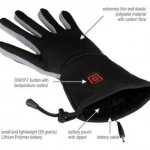
This winter, you should do your hands a favour. Even on the coldest winter days, keep your hands warm with the Thermo Gloves, the first wireless and rechargeable heated gloves worldwide that even fit underneath your other gloves. Thermo Gloves provide your hands with pleasant warmth and thus offer ideal comfort for the winter. Wear the Thermo Gloves as outer gloves, or pull on your own gloves over them. No matter whether these are mittens for taking a walk, or skiing gloves, or rubber gloves for...
More
Pulse is a Camera Add-On That Gives You Full Control from a Smartphone.

Pulse is a new camera accessory that allows you to control things wirelessly using a smartphone. It plugs into your DSLR or mirrorless camera’s USB port, allowing you to shoot photos, time-lapses, or videos from an app on your phone. Outwardly, Pulse looks like an ultra-flat flash transmitter that sits on your camera’s hotshoe with a wired connection on the side, it has a small form factor, so it’s portable and doesn’t get in the way of your photography. Inside, it packs a Bluetooth radio with a...
More
“Li-Fi” 100 Times Faster Than “Wi-Fi”

Li-fi is a new means of delivering data using visible spectrum as against the radio waves used by most other methods. This new technology has already been tested in a functional office. What makes Li-fi stand apart is the astonishing speed at which can deliver access to the internet, often 100 times faster compared to Wi-fi at a mind-boggling speed of 1Gbps. You need a light source similar to an LED bulb, a photo detector and an internet connection to use Li-fi. The visible spectrum of light use...
More
X-Ray Vision, RF Capture and Emerald
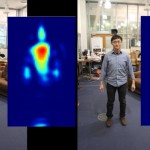
A team of researchers at MIT’s Computer Science and Artificial Intelligence Lab (CSAIL) has long believed that wireless signals like WiFi can be used to see things that are invisible to the naked eye. Since 2013, CSAIL researchers have been developing technologies that use wireless signals to track human motion. The team has shown that it can detect gestures and body movements as subtle as the rise and fall of a person’s chest from the other side of a house, allowing a mother to monitor a baby’s...
More
Tail Lights Rider System for keeping horses safe at night.

Riding horses in low light poses some obvious dangers, particularly in areas where they're forced to share the road with drivers who could become easily distracted. Sadly, for Tail Lights creator Sami Gros, it took a near-tragedy to inspire a solution. "I was out riding my two horses with my best friend, and a car hit my friend and my horse. My friend was OK, but my horse suffered injuries that has made him unridable to this day," Gros said. "I searched the internet for a product that would allo...
More
Flexible, implantable device could block pain signals

Building on wireless technology that has the potential to interfere with pain, scientists have developed flexible, implantable devices that can activate and, in theory, block pain signals in the body and spinal cord before those signals reach the brain. The researchers, at Washington University School of Medicine in St. Louis and the University of Illinois at Urbana-Champaign, said the implants one day may be used in different parts of the body to fight pain that doesn’t respond to other therapi...
More
Memory and conductivity
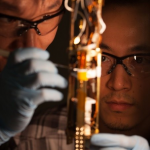
Scientists from Stanford University and the Department of Energy’s SLAC National Accelerator Laboratory have made the first direct images showing that electrical currents can flow along the boundaries between tiny magnetic regions of a material that normally doesn’t conduct electricity. The results could have major implications for magnetic memory storage. "This can provide a more straightforward way to use magnetic material as memory,” said Eric Yue Ma, a graduate student in the laboratory of Z...
More