



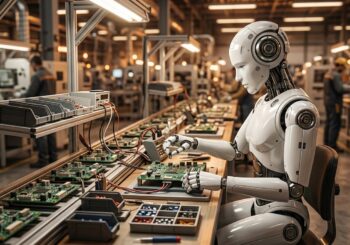


Most AI image tools are good at the first picture and worse at the fiftieth edit. Small errors pile up, colors drift and details soften. On November 9, 2026, ByteDance's Seed team introduced Seedream 5.5, an image creation model it says is built to hold up across 100 rounds of editing.
The announcement frames the model around professional production. In the team's words, what matters is whether a model can deliver usable results on deadline and within budget, not just striking demos. Seedre...
More
Rutgers Study: Iron-Nickel Catalyst Keeps Zinc-Air Cells Running
Zinc-air batteries are the quiet workhorses inside hearing aids: cheap, compact and, for the most part, thrown away after one use. A research team that includes a Rutgers professor now reports a way to make a rechargeable version run steadily for 1,000 hours, without leaning on platinum-style precious metals. The Rutgers Climate and Energy Institute summarized the work on November 4, 2026.
The study appeared in the journal Advanced Energy Materials. Tewodros Asefa, an RCEI affiliate and pro...
More
HKU Builds a Megawatt Power Module From Gallium Oxide
Every phone charger, electric car and power grid relies on semiconductor switches that control electricity. For decades those switches have been made of silicon, and silicon is nearing its physical limits. Engineers at The University of Hong Kong (HKU) now report a module built on a newer material, gallium oxide, that switched 1,000 volts and 1,000 amperes, a peak of one megawatt. According to HKU's announcement, it is the first time a module made from this class of material has reached tha...
More
MIT’s WorldParticle Simulates Sand, Fluids and Proteins in One Model
Ask a scientist to simulate a splash of water, a collapsing sand dune and a folding protein, and the honest answer is that those are three different software projects. Each phenomenon has its own governing equations, and each simulator is hand-built around them. A team from MIT and the University of British Columbia (UBC) now says one AI system can handle all three. According to MIT News, the system is called WorldParticle, and its authors describe their goal as a "GPT moment for simulation...
More
Viridien and AMESA Team Up on HPC for Enterprise AI Agents
Training an AI agent to run part of a factory or supply chain takes serious computing power, and most companies would rather not build a supercomputer to get it. On November 5, 2026, Viridien and AMESA announced a partnership aimed at exactly that gap.
Viridien, a Paris-based advanced technology and HPC company, will supply the high-performance computing infrastructure behind AMESA Agent Cloud. AMESA is an enterprise AI platform for what it calls operational autonomy.
What was announced
...
More
Sydney’s Treellis Helps People Learn While Co-Creating With AI
Type a few words, get a finished 3D design. Modern AI makes that easy, and it also hides how the result was made. A University of Sydney team says that is a problem for learning, and on November 4, 2026 it announced a tool built to fix it.
The system, called Treellis, was developed in the university's Faculty of Engineering with the University of Cambridge and Singapore Management University. The paper describing it won a Best Paper Award at ACM UIST 2026, the Symposium on User Interface So...
More
Octopus, CATL and Ampace Plan Smarter, Cheaper Home Batteries
Home batteries are quietly changing from boxes on a garage wall into connected devices that decide when to buy, store and sell electricity. On November 3, 2026, one of Europe's best-known energy retailers announced a partnership meant to speed that shift along.
Octopus Energy and Xiamen Ampace Technology Limited signed a Memorandum of Understanding (MoU) to explore next-generation smart home energy storage that pairs high-performance hardware directly with intelligent software, according to...
More
WOTA Unit Recycles Home Water for Water-Scarce Caribbean Islands
Imagine a household that takes 100 showers' worth of water out of its own wastewater in a single month. That is roughly what a Japanese company says happened in a demonstration home in Antigua and Barbuda, and it is now using the result to argue for a different way to supply water on islands.
On November 3, 2026, WOTA, a Tokyo-based water technology company and Earthshot Prize finalist, issued a news release timed to the Commonwealth Business Forum 2026, held November 2 to 4. In it, WOTA pr...
More
Snowflake CoCo Brings Governed AI Into Excel and Google Sheets
Spreadsheets have been the main way people work with data for more than 40 years, and they are also where governed data tends to escape. Someone exports a CSV, emails it, and soon several versions of the truth are circulating. Snowflake's answer, announced in early November 2026, is to bring its AI agent to the spreadsheet itself: Snowflake CoCo for Microsoft Excel and Google Sheets, now in public preview.
Snowflake's release notes date the preview to November 3, and its product blog follow...
More
PhoenixAI’s Contextbase Gives AI Agents One Place for Context
An AI agent is only as good as what it knows when it acts. It needs to know what the data means, what the business has learned before, what happened on its last run and whether that run worked. In most companies today, those pieces live in different tools. On November 4, 2026, PhoenixAI launched a product that tries to put them in one place: Contextbase.
PhoenixAI, the original creator of the StarRocks open source database and formerly known as CelerData, unveiled Contextbase at its NEXT QU...
More
MIT’s UQ-DAAAM Helps Robots Fix Their Own Wrong Memories
Picture a robot sent to fetch a wall-mounted defibrillator. If its stored memory wrongly lists that object as a fire extinguisher, it may never find the device. That example opens an MIT News report, published November 5, 2026, on a new system that lets a robot notice when its own memory might be wrong and repair it.
The system is called UQ-DAAAM, short for Uncertainty Quantification for Describe Anything, Anywhere, at Any Moment. It was developed by researchers at MIT, led by associate pro...
More
Luma’s Agent Launchpad Lets AI Agents Prep Patients for Surgery
Ask any perioperative nurse what eats the day and the answer is often the telephone. Before a colonoscopy, a knee replacement or a cataract operation, patients need to hear the same instructions again and again: what to eat, which medicines to pause, when to arrive. On November 5, 2026, Luma Health announced a product aimed squarely at that routine: Agent Launchpad, a place where health systems can run AI agents that carry a multistep task from start to finish.
Luma, which describes itself ...
More
AURORA Puts AI Co-Scientists in Cancer Grand Challenges Labs
Science has a bottleneck that has little to do with lab benches: there is simply too much published evidence and too much data for any research team to read, compare and connect by hand. On November 6, 2026, Cancer Research UK announced that three of its Cancer Grand Challenges teams will begin a rigorous test of whether AI "co-scientists" can help close that gap.
The test is the next stage of Project AURORA, an initiative the charity describes as an £8 million project. A team at Harvard Un...
More
Tiber’s MD Tutor Brings AI One-on-One Tutoring to Campuses
Article details
Primary domain: Education & Workforce Development (Personalized Learning)Secondary domain: Artificial Intelligence & Machine Learning (Multimodal AI)Article type: Product & Vendor InnovationTechnology: Tiber Tutor AI tutoring platformInnovation maturity: Early AdoptionMission: EducationBusiness impact: Extends individualized academic support beyond the classroom without adding instructor hoursAudience: Education, Business/Leadership, ITPublication date: November 2026...
More
CMU’s ESTIMATA-EX Uses Phone Photos to Estimate Surgical Blood Loss
In many operating rooms, one of the most important numbers is still an educated guess: how much blood has the patient lost? Chiang Mai University in Thailand says it has built an AI system to replace that guess with a measurement. In a university announcement dated 2 November 2026, the team introduced ESTIMATA-EX, which estimates blood loss and counts blood-soaked surgical materials from photos taken on a smartphone or tablet. This article covers the announcement as news and is not medical ...
More
Newcastle and Ufonia Trial Dora, an Empathetic AI Phone Assistant
Picture a follow-up phone call that never gets rushed, never runs late and never depends on whether a clinic has enough staff that week. That is the idea behind Dora Care, a generative AI assistant now being trialled in the UK's National Health Service. According to a Newcastle University press release published on 6 November 2026, the assistant holds spoken telephone consultations with patients who live with a long-term illness, helping clinicians keep track of how they are doing. This art...
More
MIT’s CheMeleon Predicts Molecule Behavior From Scant Data
Finding a new drug or material is mostly an exercise in elimination: chemists synthesize and test enormous numbers of molecules to find the few that behave the way they need. A machine-learning model from MIT called CheMeleon aims to shrink that pile by predicting molecular properties from very little experimental data.
According to MIT News (November 6, 2026), the work was reported in the Journal of Chemical Information and Modeling and comes from the group of chemical engineering professor Wi...
More
USF’s Self-Cooling Paint Chills Roofs Below Air Temperature
Roofs spend the day soaking up sunshine, and air conditioners spend the afternoon fighting the result. A white paint from the University of South Florida (USF) takes a different approach: instead of merely absorbing less heat, it sends heat away, and it has now been shown to cool a surface below the air around it in a month of real outdoor testing in Tampa.
According to USF's announcement on November 5, 2026, the self-cooling coating was created in the lab of Distinguished University Professor ...
More
Georgia Tech’s Biodegradable STAR Particles Open the Skin
Your skin is superb at keeping things out, which is great until a medicine needs to get in. A team at Georgia Tech has designed a fix that looks, under a microscope, like a tiny spiky ball, and on November 4, 2026 the university described a new version built to disappear after use.
A cream-friendly alternative to patches
Mark Prausnitz, a Regents' Professor in Georgia Tech's School of Chemical and Biomolecular Engineering, has spent years working on ways to move drugs through the skin's oute...
More
Harvard’s FIND Uses DNA Nanoswitches to Hunt Drug Leads
Most drugs work by changing a conversation between proteins. A hormone binds a receptor, the receptor grabs a partner, and a signal travels through the cell. Yet the standard way to search for new medicines mostly asks a narrower question: does this molecule stick to a target? On November 5, 2026, the Wyss Institute at Harvard announced a platform that asks the better question directly: does this molecule change how two proteins interact?
The platform is called FIND, short for Functional Intera...
More
UTSW’s miOPM Microscope Swaps Lenses to Image Cells in 3D
Most advanced microscopes are specialists. One is tuned for tiny structures inside a single cell, another for large tissues, another for scanning hundreds of sample dishes. A lab that wants to do all three often needs three machines. On November 5, 2026, UT Southwestern Medical Center announced a light-sheet microscope designed to change that.
The instrument, called the multi-immersion oblique plane microscope (miOPM), was developed in the lab of Reto Fiolka, Ph.D., and described in Nature Meth...
More
XPENG’s GroundingPI Puts Perception First in Physical AI
Robots are getting better at reasoning and planning, yet they still stumble on a more basic question: where, exactly, is the thing I am supposed to pick up? On November 4, 2026, XPENG announced GroundingPI, an open-source visual perception model built with researchers from Peking University, The University of Hong Kong and other institutions, that tackles that question head-on.
According to XPENG's announcement, the roughly 4-billion-parameter model reached an average score of 73.68 across 34 p...
More
MIT’s Sewn Fabric Molds Cast Concrete Beams With Less Material
Concrete is the most widely used building material on Earth, and making its key ingredient, cement, accounts for roughly 8 percent of human-caused carbon emissions, according to MIT. One of the simplest ways to cut that footprint is to use less concrete. MIT engineers have now shown a surprisingly low-tech way to do it: pour the concrete into molds sewn from fabric.
In a paper in the Journal of Building Engineering, announced by MIT News on November 6, 2026, a team led by civil engineer Josephi...
More
HKUST Stamps Out a Cheap, Long-Lived Metal Cooling Structure
Air conditioners and refrigerators quietly eat a huge share of the world's electricity, and the gases inside many of them trap heat in the atmosphere. A team at the Hong Kong University of Science and Technology (HKUST) now reports a step toward a different kind of cooling: a solid metal that gets cold when it is squeezed, built in a way that is cheap, fast to make and tough enough to run for more than 100 million cycles.
The work, published in the journal Science and described in an HKUST pres...
More
PuppyPi: A Raspberry Pi 5 Robot Dog That Takes Voice Orders
Most robot dogs on a desk are toys, and most serious quadrupeds cost as much as a car. Hiwonder's PuppyPi sits deliberately in between: a 720-gram, aluminium-framed quadruped built around a Raspberry Pi 5 that you can program in Python, run on ROS 2, and now talk to through ChatGPT-class large models. Say "find the red ball and kick it," and the robot is meant to hear you, look around, work out what you mean, and do it.
That chain, from words to perception to motion, is what researchers call em...
More
Science Tokyo Catalyst Makes Ammonia Without Precious Metals
Almost every loaf of bread on the planet owes something to ammonia. It is the starting point for nitrogen fertiliser, and a growing number of energy planners also see it as a practical way to store and ship hydrogen. The catch is that making it is one of heavy industry's dirtiest jobs. Now a team at the Institute of Science Tokyo says it has built a catalyst that makes ammonia under noticeably milder conditions, without any precious metals, and does it faster than the benchmark catalysts it was...
More
Northwestern Smartwatch Tech Reads Hands for Prosthetics
Your smartwatch knows how many steps you took and how fast your heart beat, but it has almost no idea what your hands are doing. That blind spot matters, because hands are how people act on the world, and for amputees and patients in care settings, tracking hand and arm movement can be clinically meaningful. Engineers at Northwestern University's SPICE Lab say a standard smartwatch can do far more here than it does today.According to Northwestern's November 4, 2026 announcement, the lab has bui...
More
PulseAI Wins FDA Clearance for Wearable Heart-Rhythm AI
Smartwatches have become remarkably good at recording the heart. Interpreting what they record is another matter. Anyone who has taken an on-wrist ECG and received an "inconclusive" result knows the gap between capturing a signal and making sense of it. On November 5, 2026, a Belfast company called PulseAI announced that it had received U.S. Food and Drug Administration (FDA) 510(k) clearance for an AI-powered arrhythmia analysis model built specifically for wearables, a step aimed squarely at ...
More
Garmin Descent X10: A Readable Dive Computer for All
Most people who learn to scuba dive start the same way: in a pool, with rented gear, and an instructor reminding them to watch their depth and air. The dive computer on their wrist is supposed to make that easier, yet many entry-level models have small, hard-to-read screens and menus that feel built for experts. Garmin is aiming squarely at that gap. According to Garmin's announcement on November 3, 2026, the new Descent X10 is a dedicated dive computer designed to put "critical dive informatio...
More
ZEISS TALOS: A Robot That Measures Without Markers
Walk through almost any modern car plant or aerospace hangar and you will find two kinds of robots. The first kind builds things: it welds, rivets, paints and lifts. The second kind, far rarer, checks whether the first kind did its job correctly. That second job has always been harder to automate, because a robot arm that is good enough to move a welding torch is rarely precise enough to measure a part to a fraction of a millimeter. On November 5, 2026, ZEISS announced a machine designed to clo...
More